
Typical process flow
- 1Crushing & screening
Three-stage crushing with jaw and cone crushers reduces ore to roughly 12-15 mm for grinding, with screens closing each stage.
- 2Grinding & classification
Ball mills in closed circuit with hydrocyclones liberate copper minerals to a typical 60-75% passing 200 mesh.
- 3Rougher & scavenger flotation
Collectors, frother and lime condition the pulp; rougher and scavenger cells float a bulk copper concentrate from the slurry.
- 4Regrind & cleaner flotation
Rougher concentrate is reground and cleaned over two or three cleaner stages to reach saleable concentrate grade.
- 5Concentrate & tailings dewatering
Thickeners and filters dewater the copper concentrate to transport moisture and recover process water from tailings.
The copper ore challenge
Copper recovery hinges on mineralogy. Sulfide ores such as chalcopyrite and chalcocite respond well to conventional froth flotation, while oxide minerals like malachite and azurite do not float without sulfidization and often suit acid leaching instead. Many deposits are mixed, with a sulfide core grading into an oxidized cap. Xinhai begins every copper project with a bench and pilot flotation test at its 3,000 m² mineral test center to fix the grind size, reagent suite and cleaner stages before sizing equipment.
The recommended flotation flowsheet
For sulfide ore the workhorse route is crush, grind, float. After three-stage crushing, the ore is ground in a wet ball mill in closed circuit with a hydrocyclone to liberate copper minerals, typically to 60-75% passing 200 mesh. Coarser grinds save power but lose recovery, so the liberation curve from testwork sets the target. The conditioned pulp then reports to flotation.
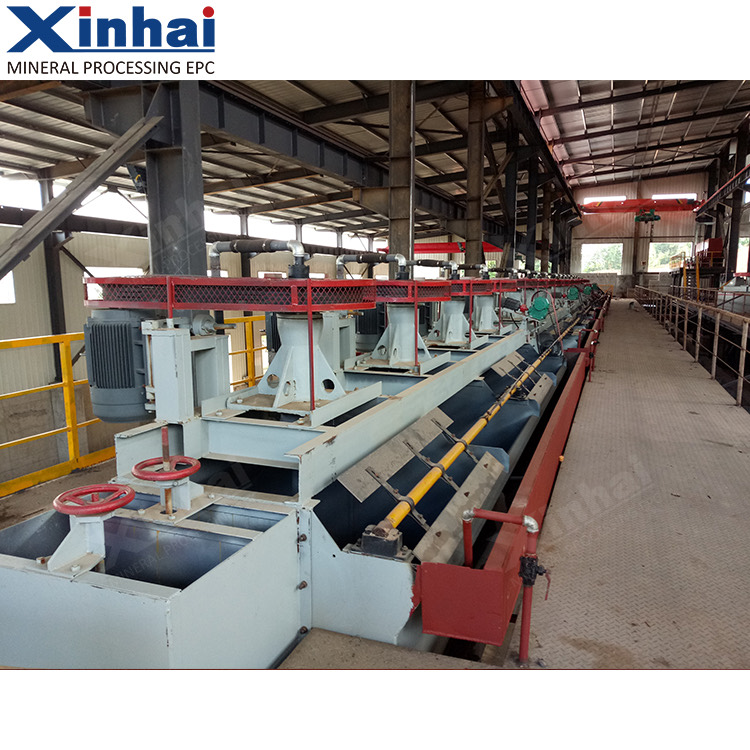
Rougher and scavenger cells pull a bulk copper concentrate using xanthate or dithiophosphate collectors with a frother and lime for pH control. The rougher concentrate is reground and upgraded through two or three cleaner stages in a JJF flotation machine circuit to reach saleable grade. Our packaged copper flotation plant integrates conditioning, rougher, scavenger and cleaner banks, and the full flotation equipment range covers cell sizes from pilot to large mechanical units. Our guide to the copper ore beneficiation flowsheet walks through reagent selection in more depth.
Reagent dosing and pH are tuned to the ore. Lime typically holds the pulp at pH 10-12 to depress pyrite and iron sulfides, while collector addition of roughly 20-100 g/t is split between the head of the rougher and the scavenger to balance grade against recovery. Where copper and molybdenum or other payable sulfides occur together, a bulk float followed by selective separation can be designed in. The rougher-cleaner configuration, regrind size and number of cleaner stages all come straight from the locked-cycle flotation test, which is the only reliable way to predict plant performance.
Cell selection follows throughput. Mechanical cells handle conditioning and roughing at scale, while column or smaller mechanical cleaner cells sharpen final concentrate grade. Wear parts such as impellers, stators and pump liners are chosen for the abrasiveness of the ground ore so that maintenance intervals stay predictable.
Oxide and mixed ore
Oxide copper is sulfidized with sodium hydrosulfide ahead of flotation, or leached with acid where flotation recovery is poor. Mixed ore often runs a sequential sulfide-then-oxide flotation circuit. The split between routes is decided by testwork, never assumed.
Closing the circuit
Final concentrate is thickened and filtered to transport moisture, while a deep cone thickener recovers process water from the tailings stream. Typical results are 85-95% copper recovery to a 20-30% Cu concentrate from clean sulfide ore, framed against your own testwork rather than promised in advance. For a representative build, see our 1,500 t/d copper flotation plant in DR Congo. As an EPC+M+O contractor, Xinhai delivers the flowsheet design, in-house manufacturing, construction and operator training as a single source. To size a plant to your deposit, contact us for an ore test.
Frequently Asked Questions
Will flotation work on my copper ore?
Sulfide copper minerals such as chalcopyrite and chalcocite float well with standard collectors. Oxide minerals like malachite need sulfidization or acid leaching instead. Most ores are a mix, so Xinhai runs a bench and pilot flotation test to confirm which route, or combination of routes, delivers the best recovery before sizing the plant.
What concentrate grade and recovery can I expect?
Clean sulfide ore typically yields 85-95% copper recovery at a concentrate grade of 20-30% Cu after rougher, scavenger and cleaner flotation. Grade and recovery trade off against each other and depend on liberation, reagents and cleaner stages, so we frame both as achievable ranges tied to your specific ore test.
How fine do I need to grind copper ore?
Typical primary grind targets are 60-75% passing 200 mesh, fine enough to liberate copper minerals from gangue. Over-grinding wastes power and can produce slimes that hurt flotation, while under-grinding leaves locked copper in the tailings. The optimum comes from the liberation curve measured during testwork on your ore.
Can Xinhai handle mixed oxide-sulfide copper ore?
Yes. Mixed ore is commonly treated with a sequential flowsheet that floats the sulfide fraction first, then sulfidizes and floats the oxide fraction, or routes oxide copper to leaching. The configuration is set by metallurgical testwork so that both mineral fractions are recovered economically rather than lost to tailings.
Related projects
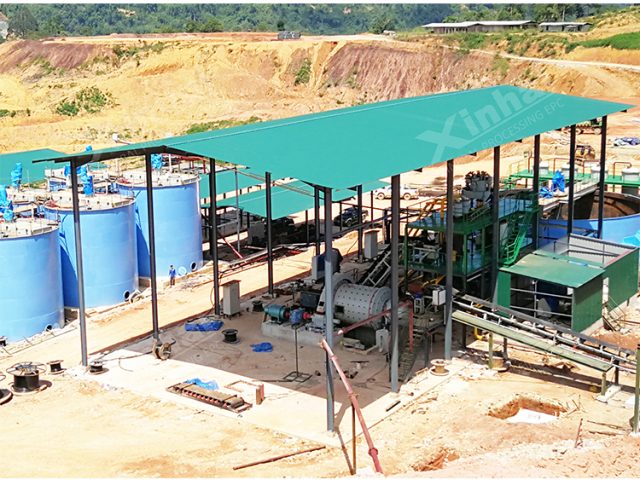
1,000 t/d Gold CIP Plant — Nicaragua
Typical 90-95% Au recovery on clean free-milling ore; CIP route lowered carbon cost
Read case →6,000 t/d Gold CIL Plant — Guinea
Typical 90-94% Au recovery on free-milling ore; built and commissioned to schedule
Read case →700 t/d Gold CIL Plant — Tanzania
Typical 89-93% Au recovery; CIL chosen to counter mild preg-robbing
Read case →