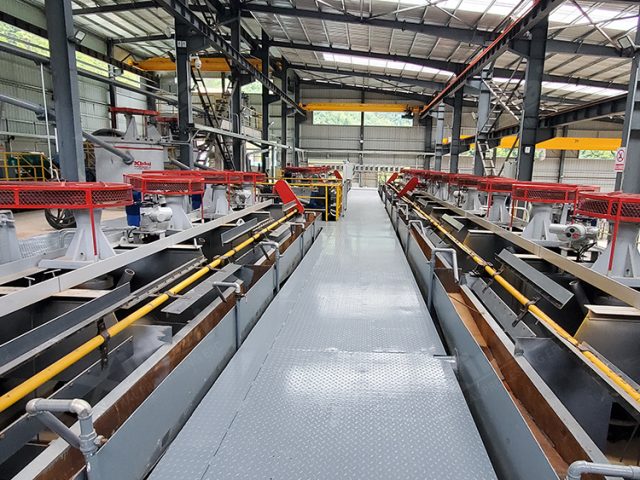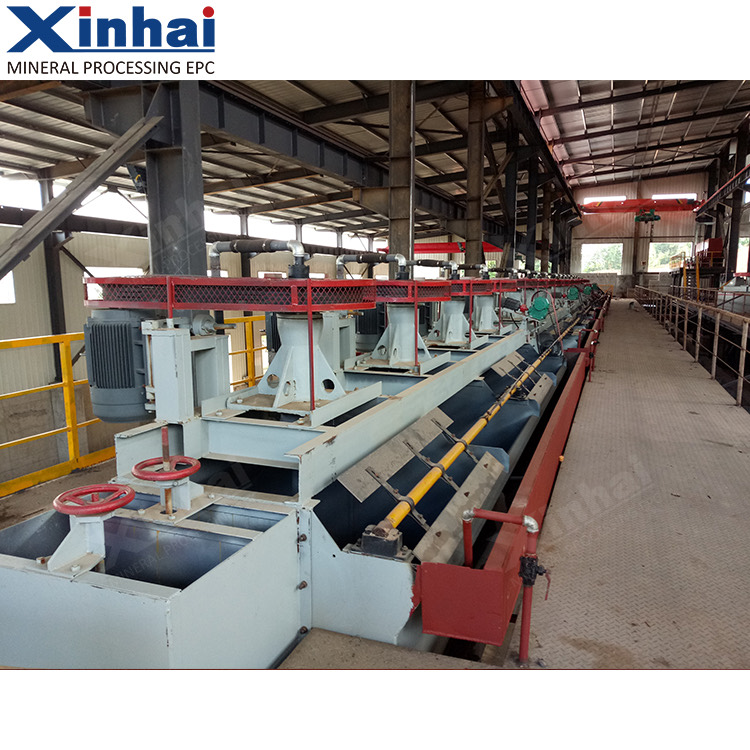
Flotation is the dominant route for recovering copper from sulfide ores, and the flotation plant is the heart of a copper concentrator. It takes finely ground slurry from the grinding circuit, conditions it with reagents, and uses air bubbles to lift copper-bearing minerals into a froth that is collected as concentrate while gangue reports to tailings. Circuit design, not a single machine, determines grade and recovery.
The standard copper flotation circuit
A typical copper circuit runs in stages so that grade and recovery can be optimized together:
- Rougher: recovers the bulk of the copper at a lower grade from fresh feed.
- Scavenger: recovers remaining values from rougher tailings to push recovery up.
- Cleaner (one or more stages): re-floats the rougher concentrate to lift grade to a salable level, often 20-30% Cu.
Reagent scheme matters as much as cells. Xanthate or dithiophosphate collectors target copper sulfides, lime controls pH (commonly 9-11 to depress pyrite), and a frother stabilizes the froth. We bench-test your ore to set the scheme before fixing cell volumes.
Equipment and sizing
The plant is built from mechanical flotation machines arranged into banks, fed by upstream wet grinding and classification. Cell number and volume are set by feed tonnage, required residence time, and float kinetics. As an OEM manufacturer, Xinhai scales the circuit from small operations to large concentrators rather than offering one fixed size. Typical copper recovery falls in the 85-95% band, with the exact figure driven by liberation, oxidation, and clay content.
From flowsheet to commissioning
A flotation plant rarely stands alone; it sits between grinding and dewatering and is best delivered as part of an integrated line through our EPC+M+O service, from ore testing and flowsheet design through manufacturing, installation, and operator training. Buying the circuit single-source keeps the grinding, flotation, and dewatering interfaces clean and shortens commissioning. For the wider context of cell types and circuit logic, see the flotation cells and machines category and our copper ore beneficiation flowsheet guide.
Share your ore grade, mineralogy, and target throughput and we will propose a circuit, expected grade-recovery, and budget. Begin on our contact page.
Technical Specifications
| Throughput | 100-3,000 t/d (configurable) |
|---|---|
| Feed | Ground slurry, typically 60-80% passing 200 mesh |
| Circuit | Rougher + scavenger + cleaner banks |
| Typical Cu recovery | 85-95% (ore-dependent) |
| Concentrate grade | Commonly 20-30% Cu (mineralogy-dependent) |
| Operating pH | 9-11 (lime control) |
| Cell power | 1.5-75 kW per cell |
| Applications | Copper sulfide, lead-zinc, molybdenum, polymetallic |
Frequently Asked Questions
What copper recovery can I expect?
For well-liberated copper sulfide ores, recovery typically falls in the 85-95% range with a salable concentrate grade around 20-30% Cu. Actual results depend on mineralogy, oxidation, clay content, and grind size, which is why we bench-test your ore and design the rougher-scavenger-cleaner circuit accordingly.
Can the same plant treat oxide or mixed copper ore?
Conventional sulfide flotation does not recover oxide copper well. Oxide and mixed ores may need sulfidization before flotation, or a leach route instead. We assess your head sample first and recommend the right flowsheet, whether that is straight flotation, sulfidized flotation, or a leach-based alternative.
How much does a copper flotation plant cost?
Individual flotation machines start from around US$8,100 per set, but a complete plant price depends on throughput, cell count, reagent system, and integration with grinding and dewatering. Because Xinhai builds to order, send your tonnage and ore data for a circuit design and budget tailored to your project.
Can Xinhai supply the whole concentrator, not just cells?
Yes. Through our EPC+M+O model we deliver the complete line, including crushing, grinding, flotation, thickening, and tailings handling, plus installation, commissioning, and operator training. Buying the circuit single-source keeps interfaces clean and shortens the path from ore testing to steady-state production.