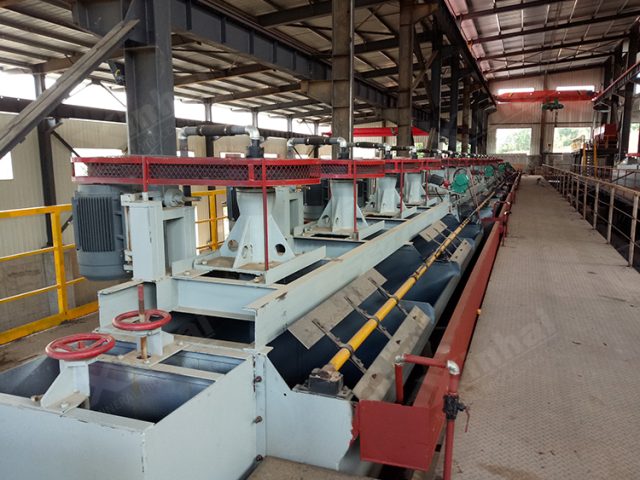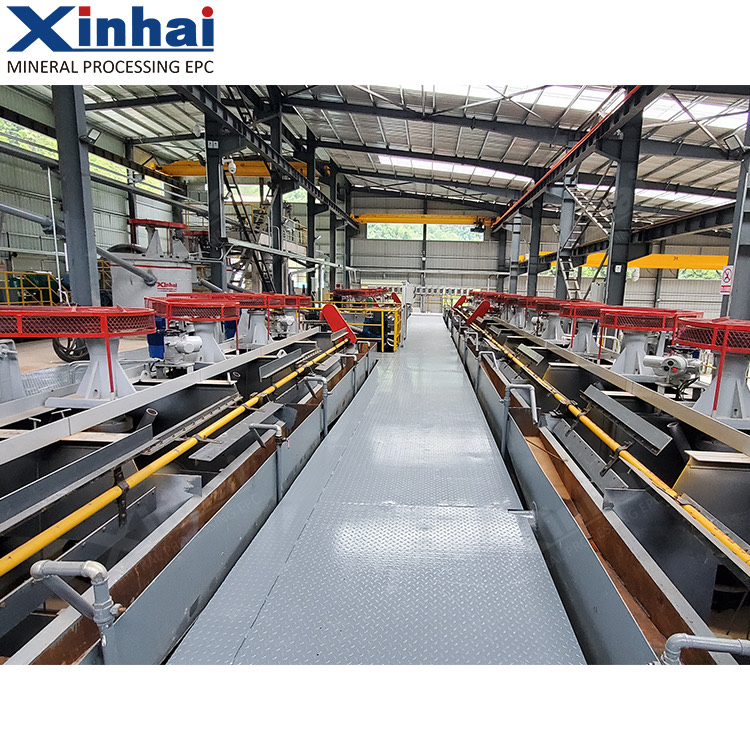
The JJF flotation machine is a mechanical, self-aerating flotation cell used to build the cell banks of a sulfide flotation circuit. Each cell agitates the slurry, draws in air, and creates a stable mineralized froth, so the right number and volume of cells gives the residence time a given ore needs to reach target recovery.
How the JJF cell works
A driven impeller rotating inside a stator generates suction that pulls air down a hollow shaft and shears it into fine bubbles distributed through the pulp. Conditioned, hydrophobic mineral particles collide with and attach to these bubbles, rise, and are removed as froth concentrate; hydrophilic gangue stays in the slurry. Because the cell is self-aerating, it needs no external blower, which lowers installed power and simplifies the layout.
- Self-aerating impeller-stator: no separate air compressor required.
- Large-volume circulation with relatively low power draw per cubic meter.
- Adjustable froth depth and pulp level for grade-recovery tuning.
- Stable, level-controlled banks that suit rougher, scavenger, and cleaner duties.
Sizing the cells
Cell selection follows the flotation kinetics of your ore. From bench and locked-cycle test data we set the total flotation volume needed for the required residence time, then split it into a practical number of cells per bank. Smaller cells (around 1-4 m³) suit cleaner and small-plant duty; larger cells (up to roughly 20 m³ in this range) handle rougher and scavenger banks at higher tonnage. As an OEM manufacturer, Xinhai matches cell count and volume to your throughput rather than forcing a fixed model.
Where JJF cells fit
JJF machines are the building blocks of plants such as our copper flotation plant and are fed by upstream grinding and classification, with the number of cells per bank set during flowsheet design. Browse the full flotation cells and machines range to compare cell types, and see our copper beneficiation flowsheet for how cells, reagents, and circuit stages work together. Complete circuits, from grinding through flotation to dewatering, can be delivered single-source through our EPC+M+O service.
Tell us your ore, target grade and recovery, and tonnage, and we will recommend cell sizes, bank layout, and a budget. Reach us via our contact page.
Technical Specifications
| Effective volume | 1-20 mu00b3 per cell |
|---|---|
| Aeration | Self-aerating impeller-stator (no external blower) |
| Motor power | 1.5-45 kW per cell |
| Feed size | Ground slurry, typically -200 mesh dominant |
| Adjustments | Froth depth and pulp level controllable |
| Duty | Rougher, scavenger, cleaner banks |
| Wear parts | Impeller and stator (replaceable) |
| Applications | Copper, gold, lead-zinc, molybdenum sulfides |
Frequently Asked Questions
What is the difference between a JJF cell and other flotation machines?
The JJF is a self-aerating mechanical cell: its impeller draws air without an external blower, lowering installed power and simplifying piping. Air-inflated designs use a separate blower for finer air control on some ores. We recommend the cell type after reviewing your froth behavior and circuit duty.
How many cells do I need?
Cell count comes from total required flotation volume, which is set by your feed tonnage and the residence time your ore needs from bench tests. That volume is then split into a practical bank, often several rougher cells plus scavenger and cleaner stages. We size the full bank during flowsheet design.
What ores suit the JJF flotation machine?
JJF cells handle sulfide minerals well, including copper, gold-bearing sulfides, lead-zinc, and molybdenum. They are designed for finely ground slurry where the valuable mineral is liberated and floatable. Oxide or mixed ores may need reagent modification or a different process, which we assess from your head sample.
How much does a JJF flotation cell cost?
Pricing starts from around US$6,480 per set and rises with effective volume, motor rating, and materials of construction. Because cells are usually bought as a bank rather than singly, send your circuit requirements and tonnage and we will quote the full set with the recommended cell sizes.