
Gravity concentration separates minerals by density difference, with no reagents, making it ideal for free gold, chrome, tin, tungsten and other heavy minerals. Centrifugal concentrators catch fine gold, shaking tables produce clean final concentrate, and spiral chutes handle high-volume coarse feed. Xinhai matches the device to your particle size and density spread.
Gravity concentration exploits the density difference between valuable minerals and gangue using water and motion rather than chemistry. It is the lowest-cost, lowest-footprint concentration route where it works, and it shines for gravity-recoverable gold, alluvial and hard-rock chromite, cassiterite (tin), tungsten and other heavy minerals. The deciding factor is the concentration criterion, the density contrast relative to the surrounding water, which predicts how cleanly a separation will run.Three machines cover most of the duty range. The gold centrifugal concentrator applies many g of centrifugal force to recover fine and flour gold down to the tens-of-microns range, ideal as a primary recovery unit on milled or alluvial feed. The gold shaker table is the classic cleaning device, producing a high-grade visible concentrate from pre-concentrated feed and excellent for final upgrading. The spiral chute separator handles high tonnage of coarser sand-sized feed with no moving parts and low power, suited to chrome, ilmenite and beach sands. Often these run in sequence: spiral or centrifugal rougher, then table cleaner.Selection turns on feed particle size, density contrast and required upgrade ratio. Coarse, free heavy minerals suit spirals; fine gold needs centrifugal force; final saleable grade usually needs a table. Feed is normally sized first through the classification circuit, and where gravity alone cannot reach payable recovery on locked gold, a gravity-then-leach hybrid with gold extraction is the standard answer.A useful screening tool is the concentration criterion, the ratio of the density difference between heavy mineral and water to that between gangue and water; values above about 2.5 indicate an easy gravity separation, while values nearer 1.25 are difficult and demand finer feed and more careful machine selection. Removing slimes before gravity is almost always worthwhile, since ultrafine particles follow the water rather than the density field and blur the separation. In practice the most robust gravity plants run in stages, a high-capacity rougher such as a spiral or centrifugal unit followed by a table cleaner, with the rougher tailings rechecked to confirm acceptable losses before the stream leaves the circuit.For how these devices compare and combine, read our gravity concentration equipment guide. Send your ore type, particle size and target grade through the contact page for a recommended gravity train.
Gravity Concentration Equipment models
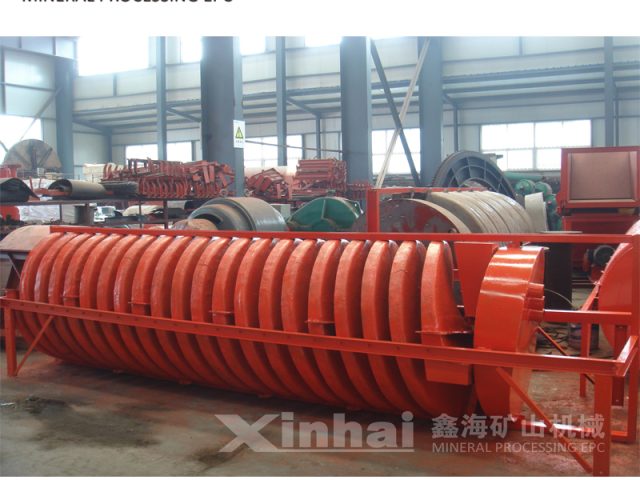
Spiral Chute Separator (Gravity Spiral)
1–8 t/h per start (multi-start available)
View details →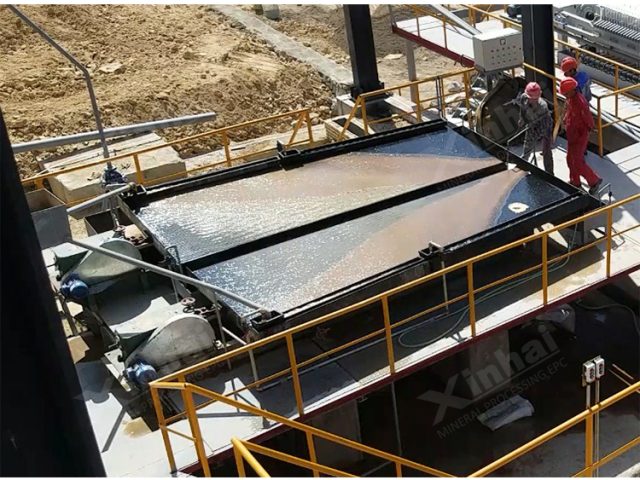
Gold Shaker Table (Gemini 6-S Concentrating)
0.1–1.5 t/h per deck (model-dependent)
View details →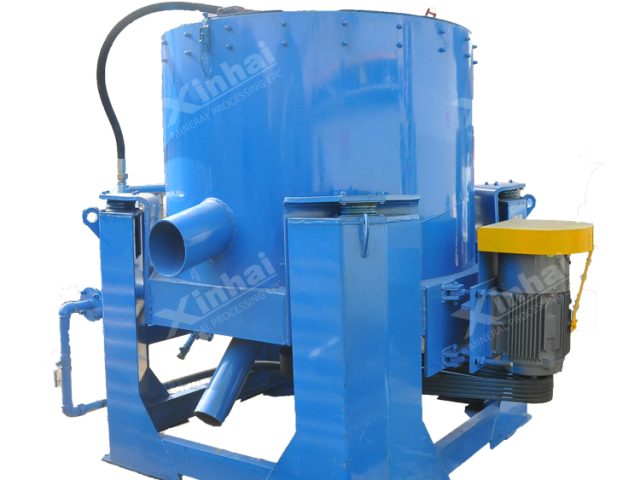
Gold Centrifugal Concentrator (Continuous)
5–100 t/h solids (model-dependent)
View details →Frequently asked questions
When should I use gravity concentration instead of flotation?
Choose gravity when the valuable mineral is significantly denser than gangue and is liberated at a usable size, common for free gold, chrome, tin and tungsten. It needs no reagents, costs less to run and is simpler to operate. Flotation becomes necessary for fine sulphide minerals where density contrast alone cannot achieve a clean separation.
How fine can a centrifugal concentrator recover gold?
Centrifugal concentrators apply many times gravity, which lets them capture fine and flour gold down to roughly 10-30 microns that would wash off a sluice or table. They work well as a primary recovery unit on milled hard-rock or alluvial feed, often followed by a shaking table to clean the concentrate to saleable grade.
Can I combine gravity equipment with leaching?
Yes, and it is common practice. A gravity circuit recovers the coarse free gold cheaply up front, reducing the load on the leach. The gravity tailings then go to a CIP or CIL circuit to recover the remaining fine and locked gold. This gravity-plus-leach hybrid often gives the best overall recovery and reagent economy.
What feed size does a shaking table need?
Shaking tables work best on sized feed, typically below about 2 mm, and ideally on a pre-concentrated stream rather than full plant feed. Classifying the feed and removing slimes first improves separation sharpness. Because a table has limited capacity, it is usually used as a cleaner downstream of a higher-capacity spiral or centrifugal rougher.