
Magnetic separation removes or recovers minerals by their magnetic susceptibility, key for iron ore concentration, manganese upgrading and purifying non-metallics like quartz and feldspar. Wet drum separators treat fine slurried feed; dry high-intensity units handle coarse or dry ore. Xinhai selects intensity and configuration to match your ore's magnetic response.
Magnetic separation sorts minerals by how strongly they respond to a magnetic field. Strongly magnetic magnetite needs only low-intensity fields, while weakly magnetic minerals such as hematite, ilmenite and manganese require high-intensity separators. The same principle works in reverse to clean iron-bearing contaminants out of silica, feldspar and other industrial minerals, raising product purity.This hub carries two complementary machines. The wet drum magnetic separator processes finely ground ore as a slurry and is the standard concentrator for magnetite and a recovery/regeneration unit in dense-medium circuits, delivering high recovery of strongly magnetic particles. The dry magnetic separator is a high-intensity drum for dry or coarse feed, used to upgrade hematite and manganese or to purify dry non-metallic minerals where adding water is undesirable. Choosing between them is first a question of feed moisture and particle size, then of the field intensity the ore’s susceptibility demands.Selection criteria are magnetic susceptibility, liberation size, feed moisture and target grade. Magnetite favors low-intensity wet drums; hematite, ilmenite and manganese need high-intensity fields. Wet feed is usually sized through classification and may be reground in the grinding circuit before separation, since liberation governs achievable grade. Where an ore carries both magnetic and non-magnetic values, magnetic separation often pairs with gravity or flotation stages in a combined flowsheet.A practical rule of thumb is to stage the separation: a rougher pass at moderate field strength catches the bulk of the magnetic mineral and rejects the obvious gangue, then a cleaner pass at higher intensity or finer feed lifts the concentrate grade. Field intensity, drum speed and feed rate are the levers an operator tunes, and they trade grade against recovery, so the right setting depends on whether the priority is a premium product or maximum yield. Drum diameter and the number of magnetic poles set capacity, while the matrix or pole gap controls how weakly magnetic a particle can be and still be captured. We confirm all of these against a magnetic susceptibility test on a representative sample before quoting, because two ores of the same metal can behave very differently under the same field.For the wet-versus-dry trade-off in detail, see our guide on wet vs dry magnetic separation for iron ore. Share your ore type, magnetic response and target grade on the contact page and we will recommend a separator and field intensity.
Magnetic Separators models
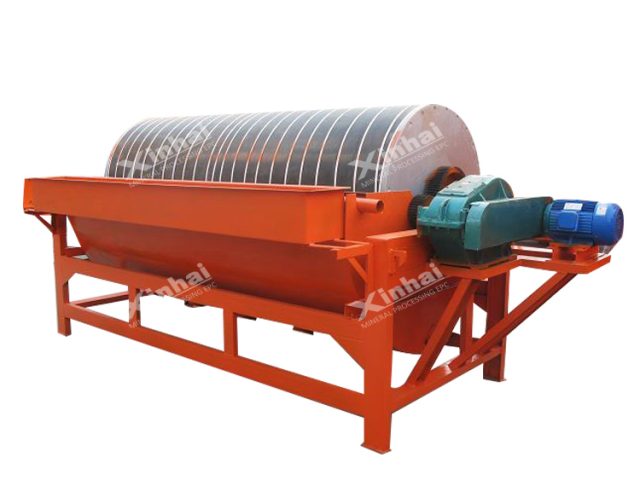
Wet Drum Magnetic Separator | High-Intensity Type
10-280 t/h (configurable)
View details →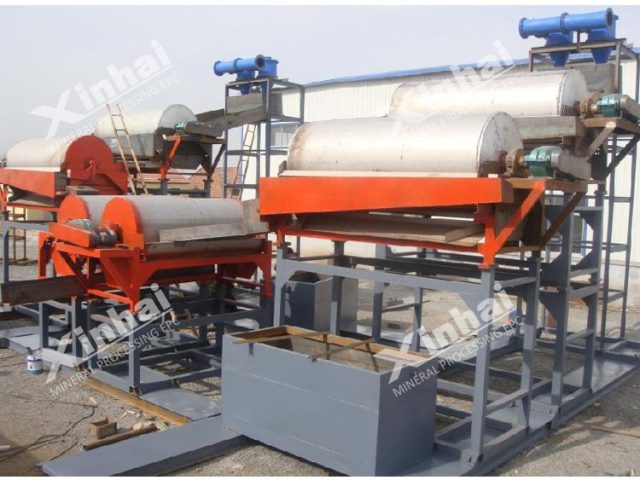
Dry Magnetic Separator | High-Intensity Drum Type
5-100 t/h (configurable)
View details →Frequently asked questions
Should I use a wet or dry magnetic separator?
Use a wet drum separator when the ore is already a fine slurry, as with magnetite headed for concentration; water improves separation of fine particles and controls dust. Choose a dry high-intensity separator for coarse feed, arid sites short on water, or dry non-metallic purification. Feed moisture and particle size usually decide before field intensity does.
Can magnetic separation upgrade hematite and manganese?
Yes, but weakly magnetic hematite, ilmenite and manganese require high-intensity separators rather than the low-intensity drums used for magnetite. Achievable grade depends on liberation, so the ore is ground to free the iron- or manganese-bearing minerals first. We match separator intensity to your ore's measured magnetic susceptibility.
Can I use magnetic separators to purify quartz or feldspar?
Yes. High-intensity magnetic separation removes iron-bearing impurities such as biotite and hematite from silica sand, feldspar and kaolin, raising whiteness and reducing iron content for glass and ceramic markets. Dry units are common for finished dry products, while wet units suit slurried feed. The target iron spec drives the number of passes.
What recovery can a magnetic separator achieve?
For strongly magnetic magnetite, wet low-intensity drums commonly recover well over 90% of the magnetic mineral, with grade set by liberation and the number of cleaning stages. Weakly magnetic ores recover lower and need high-intensity fields. We frame recovery as an achievable range confirmed by test work on your specific ore.