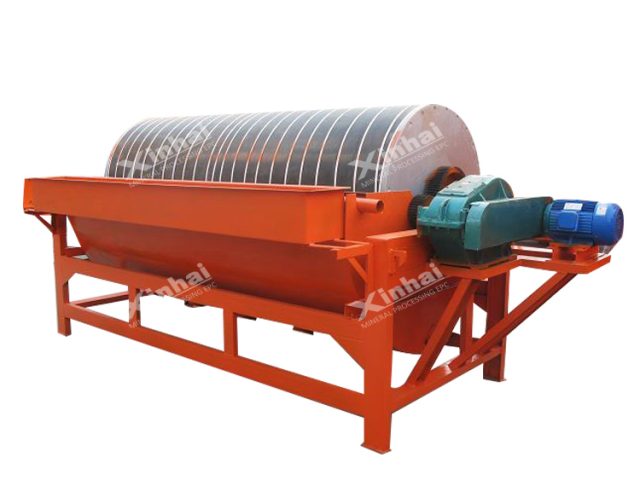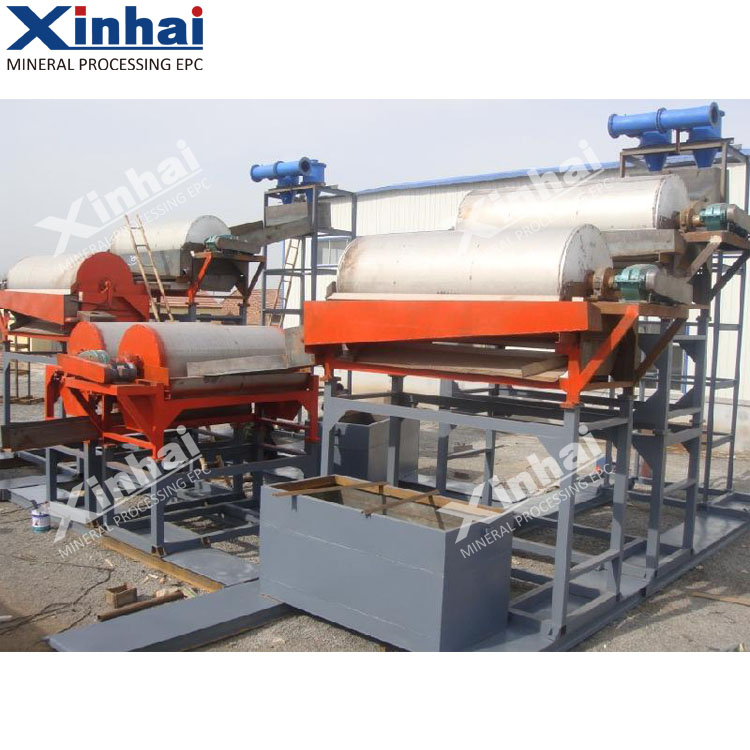
The dry high-intensity magnetic separator concentrates or cleans dry feeds without slurry. It is the practical choice where water is scarce or expensive, where the downstream product must stay dry, and for purifying non-metallic minerals such as quartz, feldspar, and silica sand by stripping out iron-bearing contaminants.
How it works
Dry, free-flowing material is fed evenly onto a rotating drum fitted with a high-intensity magnet system. Magnetic particles are attracted to the drum surface and carried around to discharge beyond the magnet arc, while non-magnetic particles follow their natural trajectory and drop earlier into a separate bin. A splitter between the streams sets the grade-recovery balance. Because there is no water, there is also no dewatering step afterward.
- No process water: lower operating cost and a simpler flowsheet.
- High-intensity field captures weakly magnetic minerals like ilmenite.
- Adjustable splitter and drum speed for grade-versus-recovery control.
- Effective for both recovering magnetics and removing magnetic contaminants.
Selection and limits
Dry separation works best on relatively coarse, dry, free-flowing material; very fine or damp feeds tend to agglomerate and separate poorly, which is where a wet machine wins. Feed should generally be dry (low surface moisture) and screened to a consistent size range for stable splitting. As an OEM manufacturer, Xinhai offers a range of drum sizes and field strengths and configures capacity to your tonnage rather than selling a single model. For iron-ore concentration, throughput per machine is lower than the wet equivalent, so the choice is driven by water availability and feed condition.
Choosing dry vs wet
If your feed is already a fine slurry, a wet drum magnetic separator usually recovers more; our wet vs dry magnetic separation guide explains when each route makes sense. Dry units pair well with dry grinding and screening lines, and are often arranged in two stages, a rougher pass followed by a cleaner, to balance recovery against product purity. See the full magnetic separators range, and ask about complete dry-process lines, from crushing through separation, through our EPC+M+O service.
Tell us your mineral, feed size and moisture, and tonnage, and we will recommend a field strength and configuration with budget via our contact page.
Technical Specifications
| Capacity | 5-100 t/h (configurable) |
|---|---|
| Feed condition | Dry, free-flowing, low surface moisture |
| Feed size | Typically 0-3 mm |
| Field type | High-intensity drum |
| Drum diameter | 600-1,200 mm |
| Adjustment | Drum speed and splitter position |
| Motor power | 1.5-11 kW |
| Applications | Dry iron ore, ilmenite, quartz/feldspar purification |
Frequently Asked Questions
When should I choose dry over wet magnetic separation?
Choose dry separation when water is scarce or costly, when the product must remain dry, or when purifying non-metallic minerals like quartz and feldspar. Dry units avoid a dewatering step entirely. For fine feeds already in slurry, a wet drum separator generally recovers more, so feed condition and site water drive the decision.
What feed moisture can the dry separator handle?
It needs dry, free-flowing feed; high surface moisture causes particles to clump and stick, which ruins separation. In practice the feed should be dried and screened to a consistent size before it reaches the drum. If your material is wet, a wet drum separator is the better and often cheaper route.
Can it purify quartz, feldspar, or silica sand?
Yes. A common use is mineral purification: the high-intensity drum strips iron-bearing and other magnetic contaminants from quartz, feldspar, and silica sand to lift product purity for glass, ceramics, and electronics feedstock. We set field strength and splitter position to the contamination level and the purity grade you need.
How much does a dry magnetic separator cost?
Pricing starts from around US$4,777 per set and scales with drum size, field intensity, and feed system. Because Xinhai builds to order, send your mineral, feed size and moisture, and required tonnage and we will quote a configuration matched to your dry-separation duty.