
Classification separates ground slurry by particle size, sending oversize back to the mill and fines forward to separation. Spiral classifiers handle coarser cuts and double as dewatering; hydrocyclones make fine, sharp cuts with no moving parts. Xinhai sizes the classifier to your grinding circuit so downstream recovery gets correctly sized feed.
Classification is the size-control step that closes a grinding circuit. After the mill, the slurry must be split: particles already at liberation size go forward to separation, while oversize returns for regrind. Getting this cut right is critical, since too coarse a feed leaves locked minerals and too fine wastes grinding energy and creates recovery-killing slimes. The choice of classifier sets the cut size and the circulating load the mill must carry.This hub covers the two dominant devices. The high weir spiral classifier uses a slowly rotating spiral in an inclined tank to lift settled coarse sand for return to the mill while overflowing the fines; it makes a coarser cut, dewaters the sand product, and is robust and easy to operate. The hydrocyclone separator uses centrifugal force in a static cone to make a fine, sharp size split with a tiny footprint and no moving parts, the standard choice for cuts below roughly 150 microns and for high-capacity circuits run in clusters.Selection depends on target cut size, capacity, and whether you want a dewatered coarse product. Spiral classifiers suit coarser cuts and double as a sand-dewatering step; hydrocyclones win on fine, precise cuts and floor space. Both pair directly with the ball mill grinding circuit and set the feed size for downstream flotation or gravity stages, where a tight size distribution improves selectivity.One number worth watching is the circulating load, the ratio of returned oversize to fresh feed; a healthy closed circuit often runs a circulating load of a few hundred percent, which keeps residence time in the mill short and the product distribution tight. Too low a circulating load usually means the classifier is cutting too coarse and letting oversize escape, while too high a load can flag an undersized mill. A hydrocyclone responds quickly to changes in feed pressure and slurry density, so it is well suited to automated control, whereas a spiral classifier is more forgiving and stable but slower to adjust. We set the cut point and circulating load against your grind target so the mill and classifier act as one balanced unit.For a direct comparison of the two technologies, read our guide on spiral classifier vs hydrocyclone. Tell us your mill throughput, target grind and desired cut size on the contact page and we will size the classification stage.
Classifiers & Hydrocyclones models
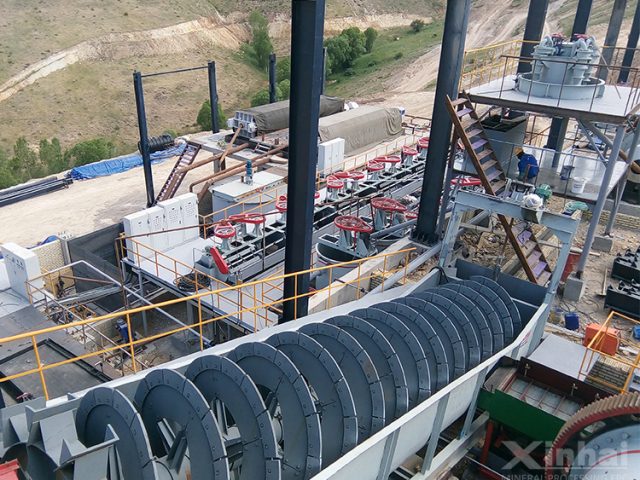
High Weir Spiral Classifier for Grinding Circuits
30-2,000 t/d sand return (configurable)
View details →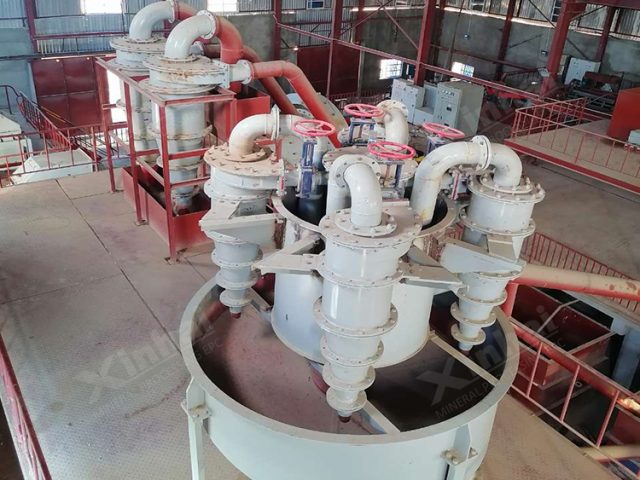
Hydrocyclone Separator | Cyclone Classifier for Slurry
Single unit or clustered radial groups (configurable)
View details →Frequently asked questions
Spiral classifier or hydrocyclone, which should I choose?
Choose a spiral classifier for coarser cuts (above roughly 150 microns) when you also want a dewatered sand product and simple, robust operation. Choose a hydrocyclone for fine, sharp cuts, high capacity and a small footprint. Many modern circuits favor hydrocyclones, but spirals remain practical for smaller or coarser-grind plants.
What does a classifier do in a grinding circuit?
A classifier splits mill discharge by size, returning oversize particles to the mill for regrind (the circulating load) and sending correctly sized fines forward to separation. This closed loop keeps the product size consistent, prevents over-grinding and ensures flotation, gravity or leaching receives feed at the proper liberation size.
How do I set the hydrocyclone cut size?
Cut size is tuned through cyclone diameter, spigot and vortex finder dimensions, feed pressure and slurry density. Smaller cyclones at higher pressure make finer cuts. For high tonnage, multiple cyclones run in a cluster. We size the unit or cluster from your target cut, throughput and slurry characteristics.
Does a hydrocyclone wear out quickly?
Hydrocyclones have no moving parts, so the main wear is on the rubber or ceramic liners exposed to abrasive slurry, especially at the apex. With wear-resistant liners and correct sizing, service life is long and parts are inexpensive to replace. We supply spare liners and recommend liner material based on your slurry abrasiveness.