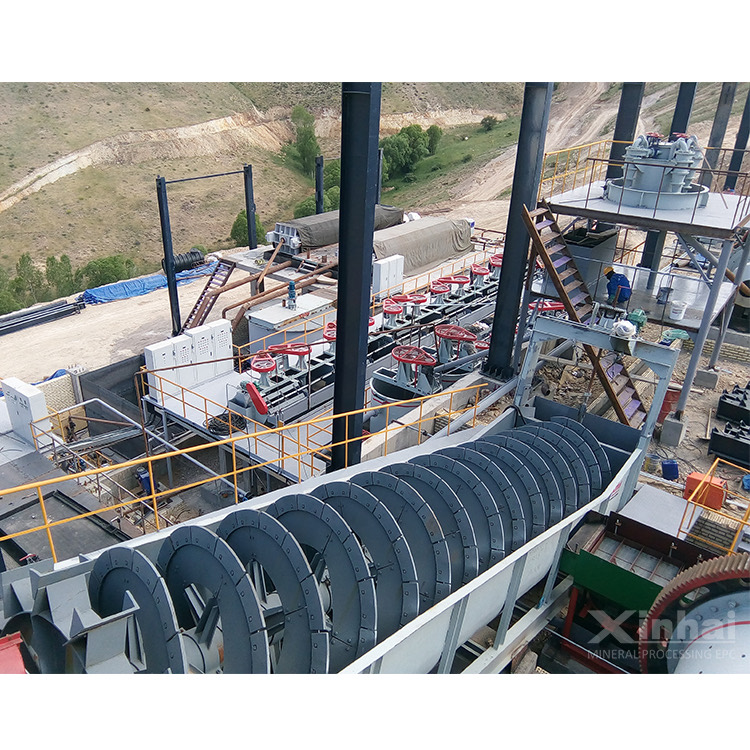
The high weir spiral classifier is a mechanical size-classification device that works in closed circuit with a grinding mill. Its job is to split mill discharge into a coarse fraction that needs more grinding and a fine fraction ready for concentration, ensuring the downstream process receives a consistent particle size.
How it works
Slurry enters an inclined tank where heavier, coarser particles settle to the bottom. A slow-rotating spiral rakes this settled sand up the slope and discharges it at the top, where it returns to the ball mill for regrinding. The lighter, finer particles stay in suspension and flow over the weir at the lower end as overflow. The high weir design positions the overflow lip above the spiral center, giving a larger settling area and a finer, more controlled overflow than a low-weir or submerged design, which makes it well suited to fine-grinding circuits.
- Returns coarse sand to the mill, preventing over-grinding and stabilizing the circuit.
- High weir gives finer overflow control for metallic-ore grinding.
- Simple, robust mechanics with low maintenance and easy operation.
Spiral classifier vs. hydrocyclone
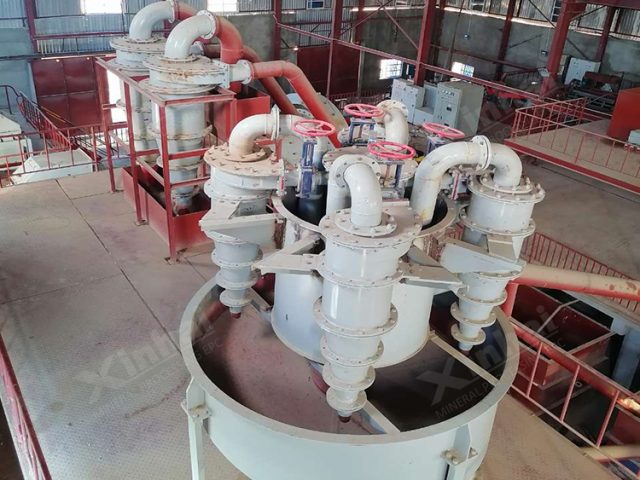
Mechanical classifiers and hydrocyclones do the same job differently. The spiral classifier is gravity-driven, gentle, easy to operate, and visible to the operator, but it has a larger footprint and a coarser practical cut size. A hydrocyclone is compact, makes finer cuts, and handles high tonnage in a small space but needs pump pressure and more wear management. Our spiral classifier vs hydrocyclone guide compares them in detail.
Sizing and integration
Classifier selection follows the mill it serves: required sand-return tonnage, target overflow fineness, and slurry density set the spiral diameter and tank length. As an OEM manufacturer, Xinhai offers single- and double-spiral units across a range of diameters and matches the unit to the wet ball mill it serves rather than offering one fixed size; the double-spiral design roughly doubles sand-return capacity for a given diameter. See the full classifiers and hydrocyclones range, and ask about complete grinding-classification circuits through our EPC+M+O service.
Send your mill size, target overflow fineness, and tonnage and we will recommend a spiral configuration and budget via our contact page.
Technical Specifications
| Sand-return capacity | 30-2,000 t/d (configurable) |
|---|---|
| Overflow capacity | Matched to mill and target fineness |
| Spiral diameter | 300-3,000 mm |
| Configuration | Single or double spiral |
| Weir type | High weir (overflow above spiral center) |
| Typical overflow | Down to ~0.15 mm cut (ore-dependent) |
| Motor power | 1.1-30 kW |
| Applications | Closed-circuit grinding, desliming, washing |
Frequently Asked Questions
What is the difference between a high weir and a submerged spiral classifier?
The high weir places the overflow lip above the spiral center, giving a larger settling pool and a finer, well-controlled overflow, ideal for closed-circuit grinding of metallic ores. A submerged spiral sits lower and is used for finer overflow and desliming. The weir height is chosen to match your target product fineness.
Spiral classifier or hydrocyclone, which should I use?
Spiral classifiers are simple, gentle, easy to watch and operate, and robust, but take more floor space and make a coarser cut. Hydrocyclones are compact, make finer cuts, and handle high tonnage but need pump pressure and wear parts. The right choice depends on cut size, footprint, and tonnage; our comparison guide covers it.
What fineness can the overflow reach?
A high weir spiral classifier practically cuts down to around 0.15 mm depending on slurry density, spiral speed, and ore type. For finer cuts you would typically move to a hydrocyclone. We set spiral diameter and speed to deliver the overflow fineness your concentration stage requires.
How much does a high weir spiral classifier cost?
Pricing starts from around US$24,777 per set and scales with spiral diameter, single versus double spiral, and tank length. Because Xinhai builds to match your mill, send your grinding circuit details and target overflow fineness for a quote sized to your throughput.