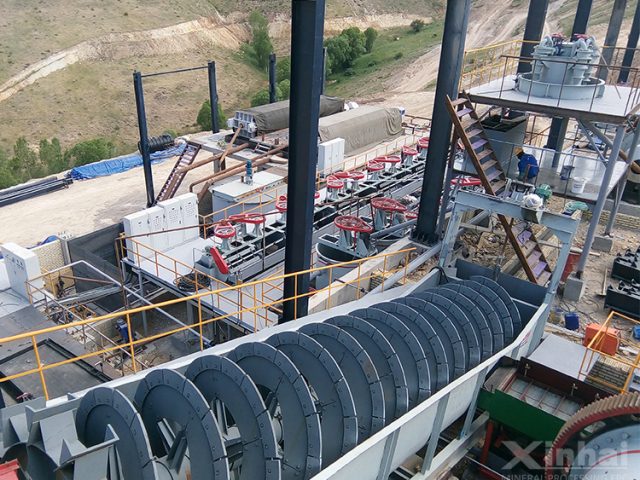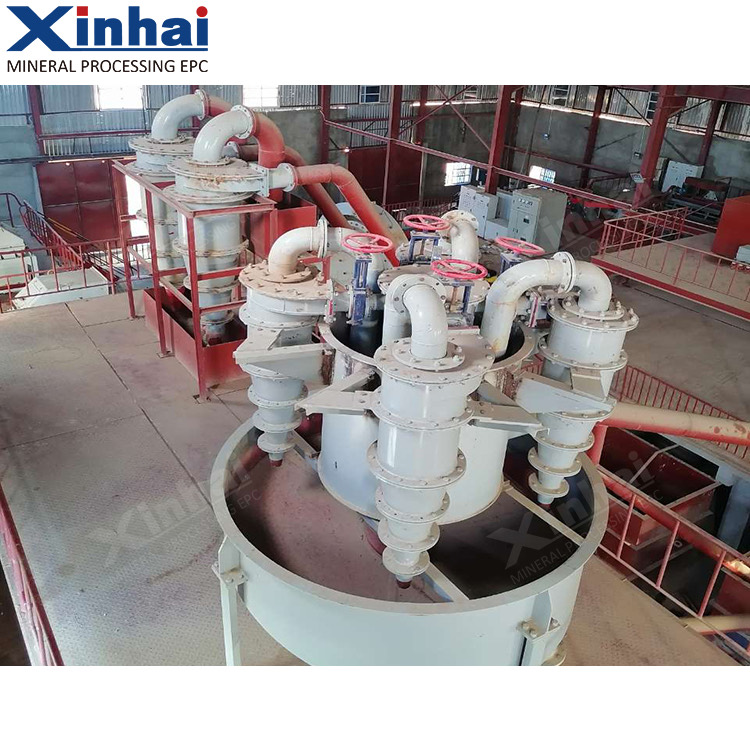
The hydrocyclone, or cyclone separator, is a compact, no-moving-parts classifier that uses centrifugal force to split a slurry by particle size. It is the high-capacity counterpart to the mechanical spiral classifier and dominates modern grinding circuits where a fine, precise cut is needed in a small footprint.
How it works
Slurry is pumped under pressure into the cylindrical top section through a tangential inlet, setting up a fast spiral flow. Centrifugal force throws coarse, heavy particles to the wall, where they spiral down the cone and exit as underflow (the coarse, dense product). Finer, lighter particles migrate to the low-pressure core and rise out through the vortex finder as overflow (the fine product). With no motor or moving parts on the cyclone itself, separation is driven entirely by feed pressure and geometry.
- Cut size set by cone diameter, spigot and vortex-finder sizing, and inlet pressure.
- Very high capacity per unit volume; small footprint versus mechanical classifiers.
- No moving parts on the cyclone; wear-resistant liners protect against abrasion.
- Easily clustered into radial groups to scale tonnage.
Cut size and wear
Smaller-diameter cyclones make finer cuts but lower throughput, so high tonnage at a fine cut is met by clustering many small units in a radial manifold. Inlet pressure, typically held in a stable band, also shifts the cut. The main consumables are the liners; Xinhai supplies rubber, polyurethane, or ceramic liners chosen to your slurry abrasiveness to control wear-part cost. As an OEM manufacturer we configure single units or clusters to your duty rather than offering one fixed model.
Cyclone vs. spiral classifier
A hydrocyclone wins on footprint, cut fineness, and capacity but needs a feed pump and active wear management; a high weir spiral classifier is simpler, gentler, and easy to watch but coarser and larger. Our spiral classifier vs hydrocyclone guide compares both. Hydrocyclones close the loop on a wet ball mill and prepare feed for downstream concentration and dewatering stages. See the full classifiers and hydrocyclones range, and ask about full circuits through our EPC+M+O service.
Send your slurry data, target cut size, and tonnage and we will recommend cyclone size or a cluster with liner choice and budget via our contact page.
Technical Specifications
| Cyclone diameter | 75-660 mm (configurable) |
|---|---|
| Capacity | Per-unit, scalable via radial clusters |
| Cut size (d50) | Fine cuts; smaller cones cut finer |
| Feed | Pumped slurry at controlled inlet pressure |
| Moving parts | None on the cyclone body |
| Liner options | Rubber, polyurethane, or ceramic |
| Configuration | Single unit or clustered group |
| Applications | Grinding classification, desliming, dewatering |
Frequently Asked Questions
How is a hydrocyclone's cut size controlled?
Cut size is set mainly by cyclone diameter, with smaller cones cutting finer at lower throughput. Spigot and vortex-finder sizing and feed pressure also shift the cut. To get high tonnage at a fine cut, many small cyclones are clustered together. We size the unit or cluster to your target cut and flow.
Hydrocyclone or spiral classifier, which is better?
A hydrocyclone is compact, makes finer cuts, and handles high tonnage but needs a feed pump and liner maintenance. A high weir spiral classifier is simpler, gentler, and easy to operate but coarser and larger. Most modern grinding circuits use cyclones; the right pick depends on cut size, footprint, and tonnage.
How long do the liners last?
Liner life depends on slurry abrasiveness, feed pressure, and percent solids. We supply rubber, polyurethane, or ceramic liners matched to your slurry: ceramic for the most abrasive duties, polyurethane and rubber for general service. Choosing the right liner is the main lever for controlling hydrocyclone operating cost.
How much does a hydrocyclone separator cost?
Pricing starts from around US$10,499 per set, with the total depending on cyclone diameter, liner material, and whether you need a single unit or a clustered group. Because Xinhai builds to order, send your slurry data, target cut size, and tonnage for an accurate, duty-matched quote.