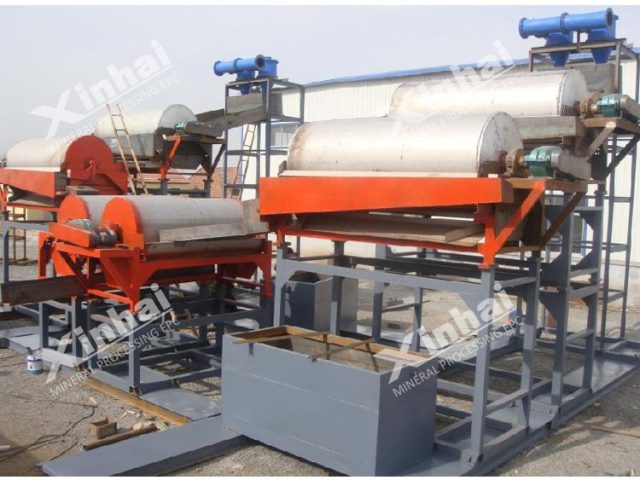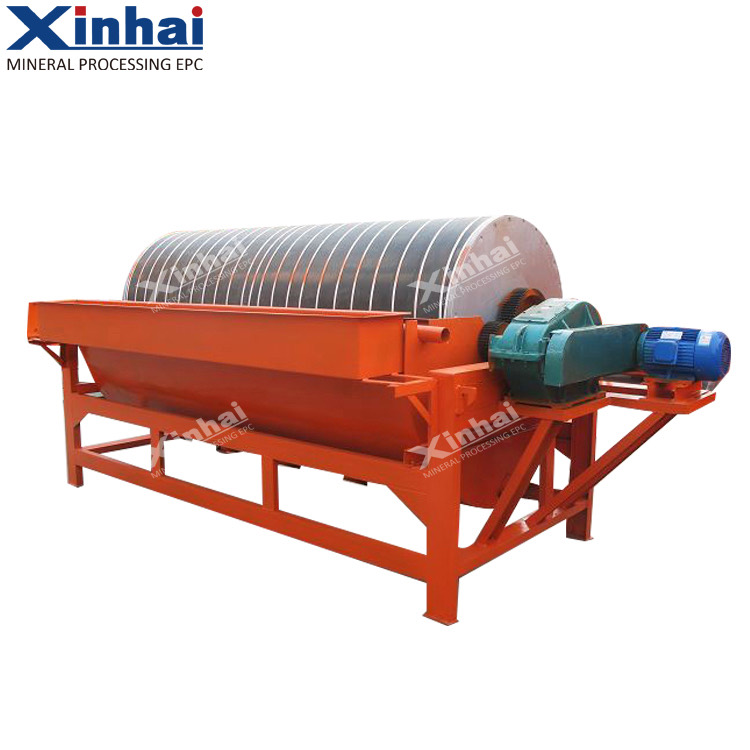
The wet drum magnetic separator is the standard tool for concentrating magnetic minerals in a slurry stream. It sits in the concentration stage of an iron-ore flowsheet, downstream of grinding and classification, and can also act as a guard unit to pull tramp magnetics out of a feed before flotation or fine grinding.
How it works
Slurry feeds into a tank where a rotating, non-magnetic drum shell turns over a stationary magnet assembly. As magnetic particles enter the field they pin to the drum surface, are lifted clear of the slurry, and are washed off into the concentrate launder past the edge of the magnet arc. Non-magnetic and weakly magnetic material flows under and out as tailings. Field strength and drum speed are the two main levers for grade-versus-recovery.
- Low-intensity (LIMS): for strongly magnetic minerals such as magnetite; high recovery at modest field strength.
- High-intensity: for weakly magnetic minerals such as roasted hematite, ilmenite, or fine iron-bearing material that a low-intensity field would miss.
Sizing and selection
Choosing a unit starts with the magnetic susceptibility of your mineral, the feed particle size, and the required tonnage. Fine, weakly magnetic feeds need a stronger field and often a slower drum for recovery; coarse, strongly magnetic feeds run faster for throughput. As a manufacturer, Xinhai offers a range of drum diameters, widths, and magnet configurations, plus single- or multi-drum tanks, rather than one fixed model. Typical concentrate grades for magnetite circuits can reach the mid-60s percent Fe when grind and field are well matched.
Wet or dry, and where it fits
Wet separation suits fine, already-slurried feeds and avoids dust; for dry, coarse, or arid-site duty, see our dry magnetic separator, and our wet vs dry magnetic separation guide compares the two for iron ore. A wet drum unit normally works in closed circuit with grinding and classification, often after two or three cleaning passes to lift the final concentrate grade; the full magnetic separators range and our EPC+M+O service cover complete iron-ore lines from crushing to dewatering.
Send your mineral, feed size, and tonnage and we will recommend a field strength, drum configuration, and budget via our contact page.
Technical Specifications
| Capacity | 10-280 t/h (configurable) |
|---|---|
| Feed size | Typically 0-3 mm (fine slurry) |
| Field type | Low-intensity (LIMS) or high-intensity |
| Field strength | Configurable to mineral susceptibility |
| Drum diameter | 600-1,500 mm |
| Tank style | Concurrent, counter-rotation, or counter-current |
| Motor power | 1.5-15 kW |
| Applications | Magnetite, roasted hematite, ilmenite, contaminant removal |
Frequently Asked Questions
What is the difference between low- and high-intensity wet drum separators?
Low-intensity (LIMS) units use a modest field and are ideal for strongly magnetic minerals like magnetite, giving high recovery cheaply. High-intensity units generate a much stronger field to capture weakly magnetic minerals such as roasted hematite or ilmenite that a low-intensity machine would lose to tailings. We match field strength to your mineral.
What concentrate grade can it achieve on iron ore?
For well-liberated magnetite, wet drum circuits commonly produce concentrates in the low- to mid-60s percent Fe, especially with multi-stage separation and a suitable grind. Grade depends on liberation, feed grade, and how many cleaning stages are used, so we tune field, drum speed, and stage count to your target.
Should I use a wet or dry magnetic separator?
Wet drum units suit fine feeds that are already in slurry and avoid dust, making them the norm for ground iron ore. Dry separators suit coarse, dry, or water-scarce operations. Our wet vs dry magnetic separation guide compares both, and we recommend the route that fits your feed and site water situation.
How much does a wet drum magnetic separator cost?
Pricing starts from around US$7,920 per set and scales with drum size, number of drums, and field intensity. Because Xinhai builds to order, send your mineral type, feed particle size, and required tonnage and we will quote a configuration matched to your separation duty.