Gravity concentration separates minerals by specific-gravity difference using water and motion. Shaking tables suit fine 0.04-2 mm feed, spiral chutes handle 0.3-0.02 mm at high tonnage, jigs treat coarse 0.5-18 mm material, and centrifugal concentrators recover fine free gold below 0.1 mm. Equipment choice depends on particle size, density contrast and throughput.
Gravity concentration is the oldest and often the lowest-cost way to recover heavy minerals such as gold, tin, tungsten, tantalum, chrome and some iron ores. It works wherever there is a meaningful specific-gravity (SG) contrast between the valuable mineral and the gangue, and it does so without reagents, which keeps operating cost and environmental risk low. The challenge is matching the right device to your particle size, density difference and target tonnage. This guide breaks down the four workhorse machines and the decision logic behind them.
How gravity separation works
Every gravity device exploits the same principle: in a moving film of water, dense particles settle, lag or report differently than light particles. The usable density contrast is commonly expressed by the concentration criterion, (SG heavy – 1) / (SG light – 1). A value above about 2.5 means easy separation at almost any size; between 1.75 and 2.5 separation is feasible above roughly 0.15 mm; below 1.25 gravity alone struggles. Gold (SG 19), cassiterite (SG 7) and chromite (SG 4.5) separate readily from silica (SG 2.65); fine coal and some oxidized ores do not.
The two variables that decide everything
- Particle size: fine feed needs gentle, film-flow devices; coarse feed needs pulsing or tumbling action.
- Throughput vs. grade: high-tonnage roughing favors spirals and jigs; final cleaning to a sellable concentrate favors tables and centrifugal bowls.
The four main gravity devices compared
| Device | Typical feed size | Capacity per unit | Best role | Typical targets |
|---|---|---|---|---|
| Shaking table | 0.04-2 mm | 0.5-2 t/h | Final cleaning / visible-grade concentrate | Gold, tin, tungsten, tantalum |
| Spiral chute (humphrey spiral) | 0.02-0.3 mm | 2-6 t/h | High-tonnage roughing/scavenging | Iron, chrome, ilmenite, zircon |
| Jig | 0.5-18 mm | 5-30 t/h | Coarse roughing, alluvial pre-concentration | Tin, tungsten, coarse gold, manganese |
| Centrifugal concentrator | <0.1 mm down to ~10 micron | 0.5-150 t/h (by model) | Fine free-gold recovery from grinding circuit | Free gold, fine PGM |
Shaking tables
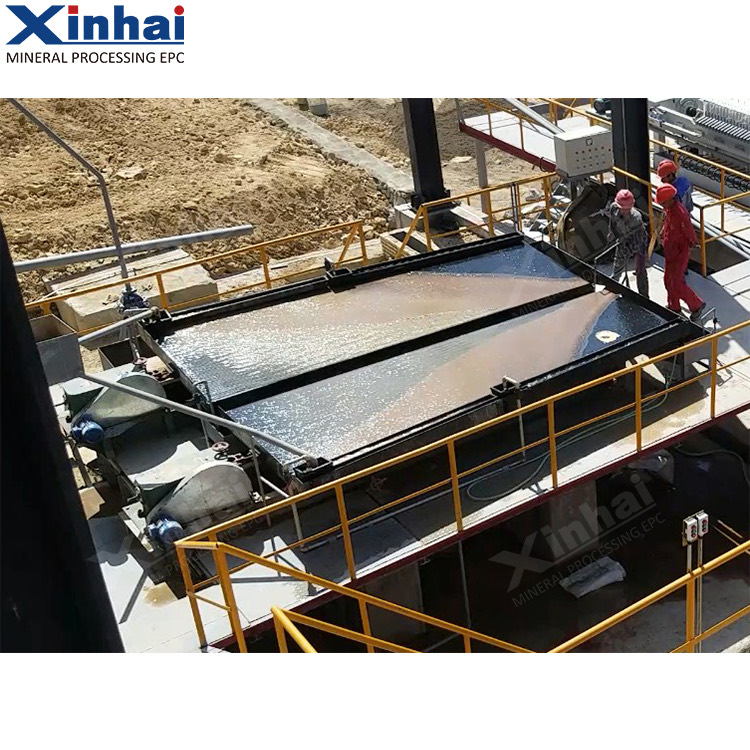
A gold shaker table uses a riffled deck with asymmetric horizontal motion and a thin cross-flow of water. Dense particles migrate along the riffles to the concentrate end while light gangue washes over the edge. Tables give the sharpest separation of any gravity device and produce a clean, high-grade concentrate, which is why they are almost always the final cleaning stage in a small gold plant. The trade-off is low unit capacity, so tables are usually fed from a pre-concentrating device rather than raw ore. Browse the full range of gravity concentration equipment to see how tables pair with upstream units.
Spiral chutes
The spiral chute separator has no moving parts: pulp flows down a helical trough and centrifugal plus gravitational forces band the minerals across the channel, where splitters cut concentrate, middling and tailing. Spirals shine on fine, high-tonnage duties such as iron ore, chromite, ilmenite and zircon sands. They are cheap to run, easy to operate and scale simply by adding starts, making them a favorite roughing device ahead of magnetic or table cleaning.
Jigs
Jigs pulse water up through a bed of particles so dense grains stratify to the bottom and report through the screen. Because they handle coarse feed, jigs are ideal for alluvial deposits, coarse gold, tin and tungsten, and for pre-concentrating run-of-mine before grinding, which cuts downstream mill load. They tolerate variable feed and require little water relative to tonnage.
Centrifugal concentrators
A centrifugal concentrator applies many times the force of gravity in a fluidized, rotating bowl, capturing fine free gold that tables and spirals lose. Installed in or after the grinding circuit, it recovers gold as soon as it is liberated, often lifting overall plant recovery by several points and reducing the gold tied up in circulating load. It is the standard answer to the question, where does my fine gold go.
Centrifugal bowls run in two modes. Batch units periodically stop to rinse a high-grade concentrate and are common in small plants and for cleaning duty, while continuous units discharge concentrate on a timed cycle without stopping the feed, suiting larger throughputs. The captured concentrate is small in mass but high in grade, so it is almost always cleaned on a shaking table before smelting. Because the bowl applies tens of g, it recovers gold down to roughly 10-25 micron that a table would lose, which is exactly the fraction that otherwise reports slowly, or not at all, to a downstream leach.
Where gravity sits in the flowsheet
In most plants gravity is not the only step. It is a fast, cheap pre-concentration stage that pulls coarse and free values early, leaving a smaller, upgraded stream for flotation or leaching. A typical gold flowsheet runs the milled pulp through a centrifugal concentrator and table to recover free gold, then sends the gravity tail to a flotation circuit or a CIL/CIP leaching plant. This hybrid approach maximizes recovery while shrinking cyanide and reagent demand. For the full picture of how recovery routes combine, see our guide to gold recovery methods compared.
Wear, water and operating cost
Part of gravity’s appeal is low operating cost, but each device has its own wear and consumable profile worth budgeting. Spirals have no moving parts, so wear is limited to the polyurethane or rubber lining of the trough and the splitters, replaced periodically. Tables wear the deck surface and riffles and depend on a reliable head-motion drive. Jigs wear screens, diaphragms and the drive mechanism, and consume ragging where used. Centrifugal bowls wear the fluidization fittings and the bowl liner. None of these approaches the reagent and energy bill of flotation or leaching, which is precisely why gravity is placed first wherever the ore allows it.
Selection checklist
- Run a particle-size and SG analysis first; size dictates the device.
- Coarse and free values: jig or centrifugal up front.
- Fine, high tonnage: spirals for roughing, tables for cleaning.
- Always confirm the concentration criterion before committing to gravity alone.
- Test on a representative sample; Xinhai’s lab can recommend a flowsheet sized to your ore.
Frequently Asked Questions
Which gravity device gives the highest gold recovery?
No single device wins alone. The highest practical recovery usually comes from combining units: a centrifugal concentrator captures fine free gold from the grinding circuit, and a shaking table cleans that concentrate to a sellable grade. Jigs add coarse gold recovery for alluvial feed. Together a well-staged gravity circuit can recover 60-90% of free gold.
Can gravity concentration replace cyanide leaching?
Only when the gold is coarse and free-milling. Gravity recovers liberated, free gold but cannot recover gold locked in sulphides or finely disseminated values. Most plants use gravity as a low-cost first stage, then leach the gravity tailing in a CIL or CIP circuit, which lowers overall reagent consumption while lifting total recovery.
What feed size is too fine for a shaking table?
Below roughly 0.04 mm (about 38 micron) a shaking table loses fine particles to the tailing because the water film overpowers settling. For values finer than this, a centrifugal concentrator that applies many g of force is the better choice. Above 2 mm, switch to a jig, which handles coarse feed efficiently.
How much water does gravity concentration use?
Water use varies by device. Spiral chutes and tables run on continuous wash water but the slurry is recyclable after thickening. Jigs use comparatively little water per tonne. In arid sites, pairing gravity with a thickener to recover process water is standard practice and reduces freshwater make-up significantly.