Gravity recovers coarse, liberated free gold cheaply and early in the circuit. Flotation concentrates fine gold locked in sulfides into a small mass for further treatment. Cyanide leaching dissolves fine and disseminated gold for the highest recovery. Most modern plants combine all three, matching each method to how the gold occurs in the ore.
There is no single best way to recover gold. The right method depends entirely on how the gold occurs in the ore – its grain size, whether it is free or locked inside sulfides, and the head grade. The three workhorse methods are gravity concentration, flotation and cyanide leaching, and the most profitable plants usually combine them. This guide explains what each does well and how to stage them.
The first question: how does the gold occur?
Before comparing methods, characterize the ore. A few questions decide the flowsheet:
- Is the gold coarse and free-milling, or fine and disseminated?
- Is it associated with sulfides (pyrite, arsenopyrite) or free in quartz?
- Is there carbonaceous material that would re-adsorb dissolved gold?
- What is the head grade, and what recovery does the economics demand?
A gravity-recoverable gold (GRG) test and a mineralogical scan answer most of this and point to the right combination.
Gravity concentration
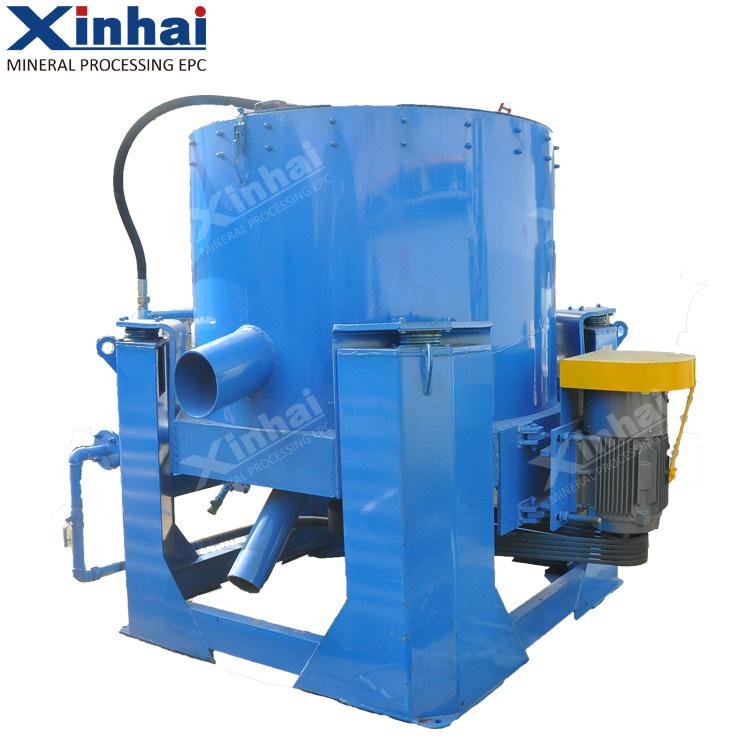
Gravity exploits the high density of gold (about 19 g/cm3) versus gangue (2.6-3 g/cm3). It is the cheapest method to run, uses no reagents, and recovers coarse free gold early so it does not get lost or over-ground. Centrifugal concentrators capture fine free gold down to tens of microns, while shaking tables and spiral chutes handle coarser fractions and produce a saleable concentrate. The limitation is that gravity cannot recover gold that is locked inside other minerals or too fine to settle.
Typical placement: a centrifugal concentrator in the grinding circuit to scalp free gold, with a shaking table to upgrade the gravity concentrate. See the full gravity concentration range for spirals and jigs.
Flotation
When gold is fine and associated with sulfides, flotation collects the gold-bearing sulfides into a concentrate that is a small fraction of the original mass. This is ideal for refractory or sulfide-hosted gold: instead of leaching the whole orebody, you leach (or smelt) only the concentrate, cutting reagent and energy cost dramatically. Flotation needs reagents and good liberation, and works best on sulfide minerals rather than free gold in oxide ore.
Cyanide leaching
Leaching dissolves gold chemically with dilute cyanide and recovers it onto activated carbon (CIL/CIP) or by zinc precipitation. It reaches the highest recoveries, 90-96% on amenable ores, and handles fine, disseminated gold that gravity and flotation miss. The trade-offs are reagent cost, residence time and the need for careful cyanide management. Leaching is applied either to the whole milled ore or, more economically, only to a flotation or gravity concentrate. See gold extraction equipment for leach tanks and the gold room.
Side-by-side comparison
| Method | Recovers | Typical recovery | Reagents | Relative cost |
|---|---|---|---|---|
| Gravity | Coarse free gold | 20-60% (of total) | None | Lowest |
| Flotation | Sulfide-locked gold | 85-95% (to concentrate) | Collectors, frothers | Moderate |
| Cyanide leaching | Fine/disseminated gold | 90-96% | Cyanide, lime, carbon | Highest opex |
Reagents and control in flotation
Flotation performance hinges on reagent selection and grind size. Collectors such as xanthates render the sulfide surfaces hydrophobic so they attach to air bubbles; frothers stabilize the bubble film; and modifiers (lime, copper sulfate, depressants) control pH and selectivity. Grind size must liberate the gold-bearing sulfides without overgrinding into slimes that float poorly. A typical sulfide gold flotation runs at a P80 around 75 microns, with the optimum confirmed by bench testwork. Because flotation rejects most of the gangue, the resulting concentrate is often 10-30 times higher grade than the feed, which is exactly what makes downstream leaching cheap.
Why most plants combine all three
A well-designed gold plant rarely relies on one method. A common high-recovery flowsheet runs gravity inside the grinding circuit to pull out coarse free gold first (which is hard to leach and easy to lose), then sends the rest to flotation or directly to leaching depending on mineralogy. For sulfide ores, gravity plus flotation concentrates the gold into a small mass that is then leached. This staged approach maximizes overall recovery while keeping reagent consumption proportional to the gold-bearing mass, not the whole orebody.
A typical free-milling flowsheet
- Crush and grind to liberation size (often 75-106 microns).
- Gravity scalp coarse free gold with a centrifugal concentrator.
- Leach the gravity tailings by CIL/CIP.
- Recover gold from loaded carbon by elution and electrowinning.
A typical refractory/sulfide flowsheet
- Crush, grind and run gravity for any free gold.
- Float the gold-bearing sulfides into a concentrate.
- Treat the concentrate (leach, or oxidize then leach).
Reading recovery numbers correctly
Be careful comparing the recovery figures for each method, because they measure different things. Gravity recovery is quoted as a share of total contained gold and is inherently limited to the coarse free fraction, so 20-60% is normal and not a weakness – it simply reflects how much of the gold is recoverable by density. Flotation recovery is quoted to concentrate, where 85-95% is typical, but that concentrate still has to be treated to produce metal. Leaching recovery is the closest to a true overall figure. The number that ultimately matters is plant recovery across the whole flowsheet, which a well-staged combination maximizes by sending each gold form to the method best suited to it.
Cyanide management is part of the design
Any cyanidation circuit must address safety and environment from the outset: pH is held around 10.5-11 with lime to keep cyanide stable and avoid hydrogen cyanide release, and tailings are detoxified before discharge. These requirements influence reagent cost and permitting, and are a reason flotation pre-concentration is attractive – leaching a small high-grade concentrate uses far less cyanide than treating the whole orebody.
Matching method to ore is the whole game
Choosing gold recovery methods is really about reading the ore correctly. Coarse free gold to gravity, sulfide-locked gold to flotation, fine and disseminated gold to leaching, and almost always a combination. Xinhai runs the gravity, flotation and leach testwork in-house, then designs the integrated flowsheet and supplies the equipment under one EPC+M+O contract. For the CIL vs CIP vs heap leach decision specifically, see our gold processing plant comparison.
Frequently Asked Questions
Which gold recovery method gives the highest recovery?
Cyanide leaching usually gives the highest overall recovery, about 90-96% on amenable ores, because it dissolves fine and disseminated gold that gravity and flotation cannot capture. However, the best total recovery often comes from combining methods: gravity first for coarse free gold, then leaching or flotation for the rest, matched to the ore's mineralogy.
Can I recover gold without cyanide?
Yes, for the right ore. Gravity concentration recovers coarse free gold with no chemicals at all, and flotation concentrates sulfide-hosted gold using only collectors and frothers. These suit free-milling or sulfide ores. For fine, disseminated gold, though, leaching is usually needed to reach commercial recovery, so many plants combine reagent-free gravity with a small leach circuit.
When should I use flotation instead of leaching the whole ore?
Use flotation when gold is fine and locked in sulfides. Flotation concentrates the gold-bearing minerals into a small mass, so you only treat a fraction of the tonnage downstream, cutting reagent and energy costs sharply. Leaching the whole ore makes more sense for free-milling oxide ores where flotation has little to grab onto.
Where does gravity fit in a gold flowsheet?
Gravity belongs inside the grinding circuit, where a centrifugal concentrator scalps coarse free gold before it can be over-ground or lost to leaching. Recovering coarse gold early protects overall recovery and produces a high-grade concentrate that can be upgraded on a shaking table. The gravity tailings then go on to flotation or leaching.
How do I know which methods my ore needs?
Run a gravity-recoverable-gold test plus a mineralogical scan and leach amenability test on representative ore. These reveal grain size, sulfide association, preg-robbing risk and head grade, which together dictate the method mix. Xinhai performs this testwork in-house and designs the matching flowsheet. Send a sample through the contact page to start.