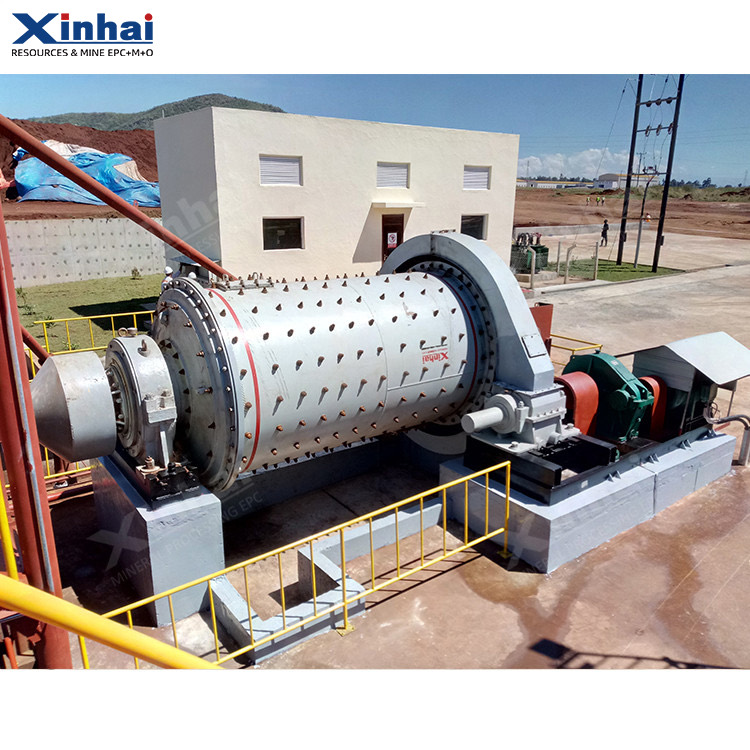
Choose a ball mill by matching mill diameter and length to your target throughput, feed size and required grind. Decide wet or dry milling, overflow or grate discharge, then size the motor and grinding media from a Bond work index. The right mill hits product size with the lowest energy and liner cost per tonne.
The ball mill is usually the largest single energy consumer in a concentrator, so getting the selection right pays back over the whole life of the plant. A mill that is undersized starves downstream recovery; one that is oversized wastes power and steel. Selection is a structured exercise: define the duty, characterize the ore, then size the mill and its wear parts. Here is how an engineer works through it.
Start with the grinding duty
Three numbers anchor every ball mill specification:
- Throughput – dry tonnes per hour the mill must process at steady state.
- Feed size (F80) – the 80% passing size of the mill feed, typically the crusher or SAG product, often 6-20 mm for a ball mill.
- Product size (P80) – the 80% passing target needed by flotation, leaching or gravity, commonly 75-150 microns, finer for refractory or fine-grained ores.
The energy to go from F80 to P80 is estimated from the Bond ball mill work index (kWh/t), measured on your ore. That energy, multiplied by throughput, gives the mill power draw, which sets the mill size. A hard ore at 15-18 kWh/t needs a much bigger mill than a soft one at 8-10 kWh/t for the same tonnage.
Wet or dry milling?
Most wet concentrators grind wet because it suits downstream flotation and leaching, gives finer products at lower energy, and controls dust. Dry milling is reserved for moisture-sensitive products, some industrial minerals, and arid sites where water is scarce. If you are grinding ahead of cyanidation or flotation, a wet ball mill is almost always the right call. For dry fine grinding of non-metallics like limestone or barite, a Raymond roller mill often beats a dry ball mill on energy.
| Consideration | Wet ball mill | Dry ball mill |
|---|---|---|
| Energy per tonne | Lower | Higher |
| Product fineness | Finer, easier | Coarser, harder |
| Downstream fit | Flotation, leach, gravity | Dry products, some minerals |
| Dust / water use | No dust, needs water | Dusty, no water |
Overflow vs grate discharge
Overflow mills are simpler and give a finer, cleaner product, ideal as the final grinding stage before flotation or leaching. Grate-discharge mills hold a lower slurry level and discharge faster, giving higher throughput and a slightly coarser product, which suits the primary stage or where overgrinding must be avoided. As a rule of thumb, use grate discharge for coarse primary grinding and overflow for fine regrind or single-stage duties.
Sizing media, liners and the motor
Once the mill diameter and length are set, three wear-and-power choices follow:
- Grinding media: ball charge is typically 30-40% of mill volume. Top ball size scales with feed size and ore hardness; a mixed charge maintains an efficient size distribution. Steel consumption commonly runs 0.5-1.5 kg/t.
- Liners: rubber liners suit fine grinding and lighter media; steel or composite liners handle coarse, abrasive duties. Liner profile affects lifting action and energy efficiency.
- Drive: mill speed is set around 70-80% of critical speed. The motor is sized to the calculated power draw plus a margin for ore variability.
Where the mill sits in the circuit
A ball mill rarely works alone. It is paired with a classifier so coarse material is returned for regrinding while fines pass on, forming a closed circuit. Whether you close the circuit with a high weir spiral classifier or a hydrocyclone affects the achievable product size and circulating load. Browse the full ball mills and grinding machines range to match the mill to your front-end crushing and classification.
Open vs closed circuit and circulating load
Almost all production ball mills run in closed circuit, where oversize from the classifier returns to the mill feed. The circulating load – the ratio of recycled coarse material to fresh feed – is typically 200-350% in a well-tuned circuit. A higher circulating load lets the mill grind at a coarser internal size distribution, which is more energy-efficient and reduces overgrinding, but it demands more pumping and classifier capacity. Open-circuit grinding (no return) is simpler but produces a wider size distribution and is generally reserved for coarse or single-pass duties.
Single-stage vs two-stage grinding
A single ball mill can take crusher product directly to final size on softer ores or modest tonnages. For hard ores, fine products, or large throughput, a two-stage layout – a primary mill (often grate-discharge) followed by a secondary overflow mill, or a SAG mill ahead of a ball mill – spreads the duty and gives better control. The split between stages is set so neither mill is the sole bottleneck. This is decided during flowsheet design from the work index and target P80.
Common mistakes when specifying a mill
- Sizing on nameplate, not ore. Two ores at the same tonnage can need very different mills if their work indices differ. Always test the actual ore.
- Ignoring ore variability. Hardness changes with depth and zone. A motor sized only for average ore stalls on the hard fraction; build in a margin.
- Mismatching the classifier. A mill is only as good as the circuit it closes. Undersized cyclones or pumps cap real throughput regardless of mill size.
- Wrong liner for the duty. Steel liners in a fine-grind rubber-liner duty waste energy; rubber in a coarse abrasive duty wears out fast.
A practical selection checklist
- Confirm throughput and operating hours per year.
- Get F80 and P80 from your flowsheet and recovery requirements.
- Run a Bond work index on representative ore.
- Calculate power draw and select mill diameter and length.
- Choose wet/dry and overflow/grate to suit the duty.
- Specify media, liners and drive; confirm circulating load with the classifier.
Xinhai sizes mills from ore testwork rather than catalog defaults, with capacities configurable from small pilot units up to large production mills. Because we also design the surrounding crushing and classification circuit under one EPC+M+O contract, the mill, motor and wear parts are matched to your actual ore and target tonnage.
Frequently Asked Questions
How do I size a ball mill?
Size it from three inputs: throughput in t/h, feed size (F80) and product size (P80). A Bond work index measured on your ore gives the grinding energy in kWh/t; multiplying by throughput sets the power draw, which determines mill diameter and length. Wet/dry and discharge type are then chosen to match the duty.
Should I choose a wet or dry ball mill?
Choose a wet ball mill when grinding ahead of flotation, leaching or gravity, since it uses less energy, reaches finer sizes and avoids dust. Choose dry milling only for moisture-sensitive products or water-scarce sites. For dry fine grinding of industrial minerals, a Raymond roller mill is often more energy-efficient than a dry ball mill.
What grind size does a ball mill produce?
Ball mills typically deliver an 80% passing size (P80) between roughly 75 and 150 microns, and can go finer for fine-grained or refractory ores when run in closed circuit with a classifier. The exact product size depends on ore hardness, mill speed, media charge and circulating load, all confirmed during flowsheet design.
How much grinding media does a ball mill use?
Steel ball consumption commonly runs about 0.5-1.5 kg per tonne of ore, depending on ore abrasiveness, grind fineness and ball quality. The ball charge usually occupies 30-40% of mill volume. Using high-quality forged or cast media and the right top ball size keeps consumption and cost per tonne down.
Can Xinhai match the mill to my existing circuit?
Yes. We design the mill around your feed and product size, throughput and the classifier you use to close the circuit, whether that is a spiral classifier or hydrocyclones. We can supply the mill alone or as part of a complete grinding and classification package. Send your flowsheet details through the contact page.