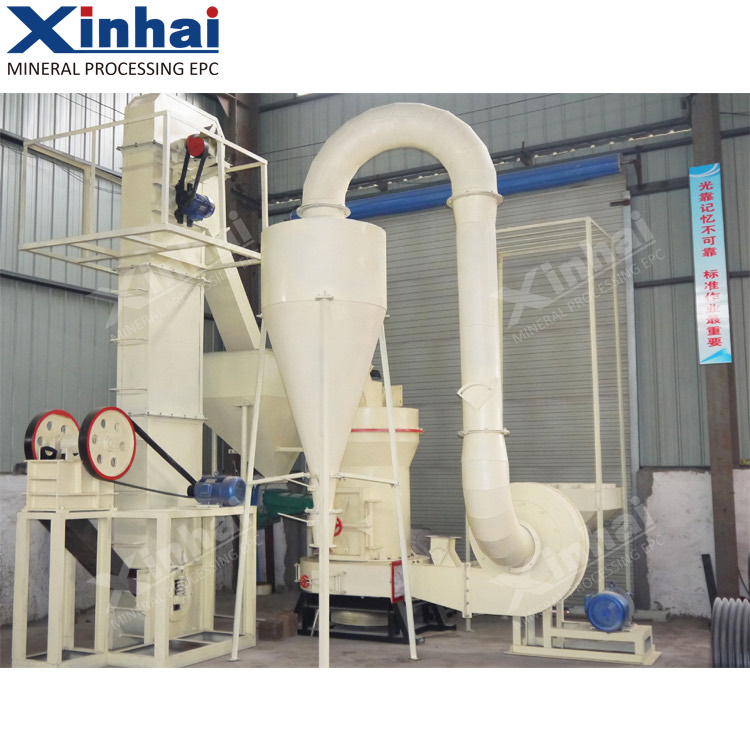
The Raymond roller mill, also called a Raymond pulverizer, is a closed-circuit dry grinding system for non-metallic minerals below about Mohs 7. Unlike a wet ball mill, it produces a dry powder and integrates grinding, classification, and collection in one footprint, which makes it the default choice for limestone, calcite, gypsum, dolomite, barite, and kaolin powder plants.
How it works
Material drops onto a rotating grinding table where spring-loaded rollers press it against a stationary ring. An upward air stream lifts the ground powder into an integral classifier; particles at target fineness pass through to the cyclone and bag collector, while oversize falls back for regrinding. The result is a tightly controlled product distribution with low residue.
- Adjustable fineness: typically 80-325 mesh, up to roughly 400 mesh on softer minerals.
- Dry, closed-circuit operation: no slurry, no dewatering step.
- Integrated classifier and dust collection for a clean, compact line.
Selection and sizing
Three variables drive mill selection: feed hardness and moisture, target fineness, and required output. Softer minerals at coarser settings give the highest throughput; pushing fineness toward 325-400 mesh lowers capacity, so the classifier speed and roller pressure are tuned accordingly. Feed moisture should generally stay under about 6% for stable airflow. As a manufacturer, Xinhai offers a range of roller numbers and ring diameters rather than one model, so capacity and motor power are matched to your powder spec.
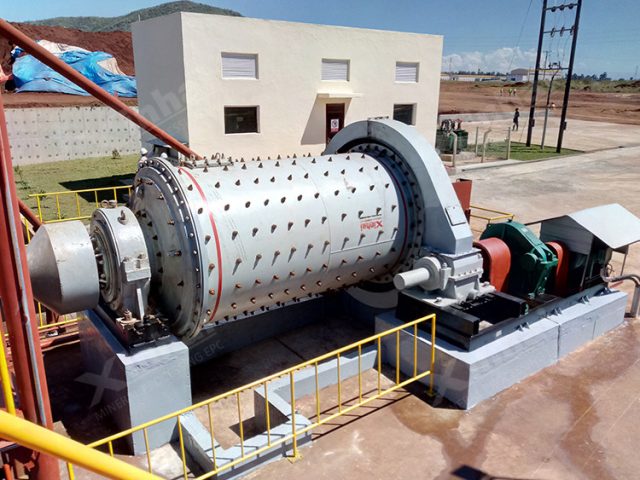
For minerals that are too hard or that need a wet flowsheet, a tumbling mill is the better tool; see our wet ball mill and the wider ball mills and grinding machines category. To understand where grinding sits relative to classification, our guide on choosing a grinding mill covers the circuit logic.
Wear parts and operating cost
The main consumables are the roller sleeves and grinding ring, both made from wear-resistant alloy and stocked as spares. Because the mill runs dry with internal classification, operating cost is driven mainly by power and wear-part replacement rather than reagents or water. Energy-efficient design and a well-tuned classifier keep specific energy competitive for fine powder duties.
Tell us your mineral, feed size, target mesh, and tonnage, and we will recommend a configuration with budget and lead time. Start the conversation on our contact page.
Technical Specifications
| Capacity | 1-25 t/h (varies with fineness and mineral) |
|---|---|
| Feed size | Up to 30 mm |
| Product fineness | 80-325 mesh standard; up to ~400 mesh |
| Feed moisture | < 6% recommended |
| Roller number | 3-5 (configurable) |
| Main motor power | 18-280 kW |
| Wear parts | Alloy roller sleeves and grinding ring |
| Applications | Limestone, calcite, gypsum, kaolin, barite (Mohs < 7) |
Frequently Asked Questions
What fineness can a Raymond roller mill produce?
Standard output is adjustable between roughly 80 and 325 mesh by changing classifier speed and roller pressure, with up to about 400 mesh achievable on softer minerals. Finer settings reduce throughput, so we balance the fineness target against required tonnage when sizing the mill for your product.
What materials can it grind?
It suits non-metallic minerals up to about Mohs 7, including limestone, calcite, dolomite, gypsum, barite, bentonite, and kaolin. It is not intended for metallic ores or very hard, abrasive rock, which are better handled by a wet ball mill in a slurry circuit followed by classification.
How much does a Raymond roller mill cost?
Pricing starts from around US$19,000 per set and scales with roller number, ring diameter, motor power, and the dust-collection package. Because Xinhai builds to order, send your mineral, target mesh, and output rate for an accurate quote that reflects your specific powder plant requirements.
Does it need a separate classifier and dust collector?
No. The Raymond mill is a closed-circuit system with an integral classifier, and the standard line includes a cyclone and bag collector for the finished powder. This keeps the footprint compact and the workspace clean, with oversize automatically returned to the grinding zone for reprocessing.