Enhanced-gravity recovery of fine free gold
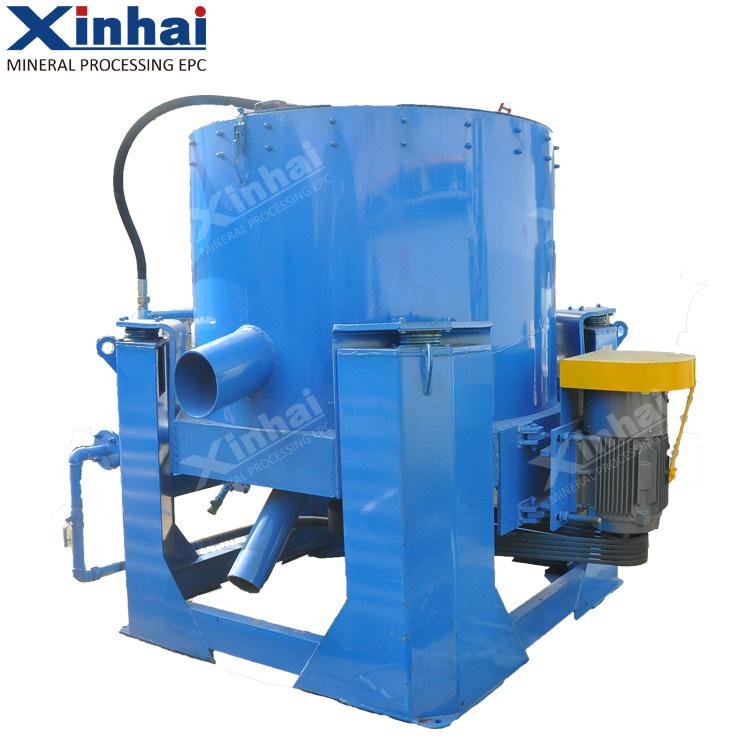
Conventional gravity devices struggle with fine and flaky gold below about 100 microns. A centrifugal concentrator solves this by spinning the slurry so heavy gold experiences many times normal gravity, letting it settle and lock into the bowl while light gangue is flushed away. It is the go-to unit for capturing liberated gold quickly, with no cyanide or other reagents, which makes it attractive where permitting or water chemistry rules out leaching.
How the continuous concentrator works
Feed slurry enters a rotating bowl lined with riffle rings. Fluidization water injected through the rings keeps the bed loose so dense gold particles migrate inward and pack, while quartz and other light gangue report to tailings. In a continuous unit, concentrate is discharged automatically on a timed cycle rather than requiring a full stop to rinse, so it runs in line with the plant without batch interruptions and needs little operator attention.
Where it fits in a gold flowsheet
- Alluvial gold: as a primary recovery stage after screening to catch fine free gold.
- Grinding-circuit scalping: on a cyclone underflow or mill discharge to pull coarse free gold out before it over-grinds or reaches leaching, where it can lock up in carbon.
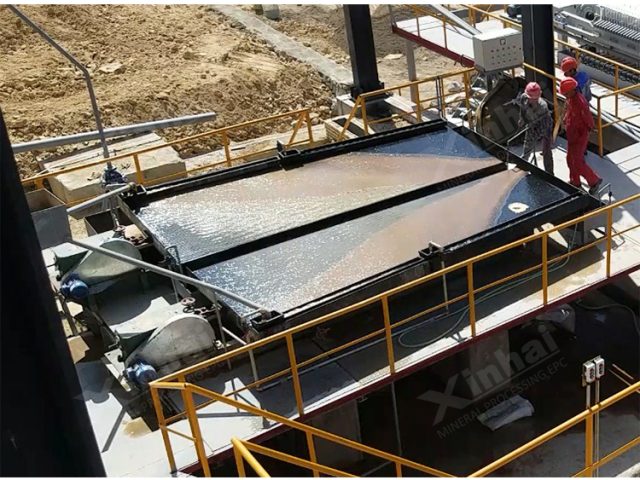
- Concentrate upgrade: ahead of a shaking table for a final clean, saleable concentrate.
Recovery of liberated fine gold is commonly in the 90 percent-plus range on suitable feed, with concentration ratios high enough to produce a smeltable product after table cleaning. Because there are no reagents and the wear parts are limited mainly to the bowl liner and fluidization ring, operating cost per ton is low and maintenance is simple. Fluidization water pressure is the key control variable, and it is set during commissioning to balance recovery against concentrate grade for your particular gold. Sizing follows your solids throughput and the gold size distribution rather than a single nominal rating.
Part of the gravity circuit
A centrifugal concentrator rarely works alone; it pairs with screening, classification and a cleaning table to deliver a finished concentrate. Xinhai supplies the unit standalone or as part of a complete gravity concentration circuit under our EPC+M+O model. Compare devices in our gravity concentration guide, or contact us with your feed data for sizing.
Technical Specifications
| Type | Continuous-discharge centrifugal concentrator |
|---|---|
| Capacity | 5u2013100 t/h solids (model-dependent) |
| Best feed size | Fine free gold, roughly <2 mm to micron range |
| Typical recovery | 90%+ on liberated fine gold |
| Reagents | None; water-only operation |
| Power | 4u201330 kW (size-dependent) |
| Main wear parts | Bowl liner, fluidization ring |
| Application | Alluvial recovery, grinding-circuit gold scalping |
Frequently Asked Questions
What gold size can a centrifugal concentrator recover?
Its main advantage is capturing fine and flaky free gold, often below 100 microns, that sluices and tables lose. The high G-force lets dense fine gold settle against the wash water. It works best on liberated gold, so feed should be screened or ground to free the gold before concentration.
Does it use any chemicals?
No. The concentrator is purely physical, using centrifugal force and fluidization water to separate heavy gold from light gangue. That makes it environmentally clean and low cost to run, and it is often used to recover gold ahead of, or instead of, a cyanide circuit where the gold is coarse and free enough.
Can it replace a shaking table?
They complement each other. The centrifugal concentrator produces a high-grade rougher concentrate at high throughput, but that concentrate is usually cleaned on a shaking table to reach a smeltable grade. For a finished product we typically pair the two, with the concentrator as rougher and the table as cleaner.
How do I choose the right size?
Sizing depends on your solids throughput and the gold particle-size distribution. A grinding-circuit scalping duty and an alluvial primary-recovery duty call for different models. Send us your feed rate, gold size and head grade, and we will recommend a unit and where to place it in the circuit.