Choose CIP for clean, free-milling ores where leaching finishes before carbon adsorption; CIL when the ore is preg-robbing or slow-leaching, since leaching and adsorption run together; and heap leach for large, low-grade oxide deposits where low cost outweighs lower recovery. Grade, mineralogy and throughput drive the decision.
Picking between CIL, CIP and heap leach is the single biggest flowsheet decision for a cyanidation gold project. All three dissolve gold with a dilute cyanide solution, but they differ in how and where the dissolved gold is recovered, and that drives capital cost, recovery and the kind of ore each one handles well. Below is a process engineer’s view of how to match the method to your deposit.
The three methods at a glance
CIP (carbon-in-pulp) and CIL (carbon-in-leach) are both tank-leaching routes that produce a high-grade dore and suit higher-grade ore. Heap leach is a low-cost, lower-recovery route for large tonnages of low-grade oxide ore. The core difference between CIP and CIL is timing: in CIP the ore is fully leached first, then pumped to separate adsorption tanks where activated carbon captures the gold; in CIL, carbon is added directly to the leach tanks so dissolution and adsorption happen at the same time.
| Factor | Heap Leach | CIP | CIL |
|---|---|---|---|
| Typical ore grade | 0.3-1.5 g/t (oxide) | 1-15+ g/t | 1-15+ g/t |
| Typical gold recovery | 50-75% | 90-96% | 90-96% |
| Relative capex | Lowest | Moderate | Moderate |
| Leach time | 30-90+ days | 20-40 h | 20-40 h |
| Best for preg-robbing ore | No | No | Yes |
| Footprint | Very large pads | Compact | Compact |
When CIP makes sense
CIP is the classic choice for clean, free-milling ores that leach quickly and have no carbonaceous (preg-robbing) minerals to re-adsorb dissolved gold. Because leaching is completed before adsorption, you can optimize each step independently, and the smaller number of carbon-handling tanks keeps screen wear and operating attention lower. CIP plants are well suited to deposits in the roughly 100-1,200 t/d range where the cyanide-soluble gold is fully liberated after grinding to about 70-80% passing 75 microns.
Where CIP struggles
If the ore contains organic carbon, clays or fine sulfides that slow leaching, gold can re-deposit onto those minerals before it is recovered. That is the case CIL was designed for.
When CIL is the safer route
In CIL, activated carbon sits in the leach tanks and continuously strips dissolved gold out of solution the moment it forms. This protects recovery on preg-robbing and slow-leaching ores and shortens overall residence time, since leaching and adsorption overlap. CIL has become the default for many new gold plants because it is forgiving of mineralogical surprises. The main trade-offs are slightly higher carbon inventory and more carbon attrition, so robust interstage screening and a well-sized elution and electrowinning system matter.
- Choose CIL if: the ore is carbonaceous/preg-robbing, leaches slowly, or you want a single forgiving flowsheet for variable feed.
- Choose CIP if: the ore is clean and free-milling and you want simpler, lower-attrition carbon handling.
- Choose heap leach if: you have large tonnages of low-grade oxide ore and capex/opex per tonne is the priority.
When heap leach wins on economics
Heap leach trades recovery for cost. Crushed (or sometimes run-of-mine) ore is stacked on a lined pad, irrigated with cyanide solution, and the pregnant leachate is collected and sent to carbon columns or a Merrill-Crowe circuit. Recovery is lower and leach cycles run weeks to months, but you avoid fine grinding, agitation tanks and most of the mechanical plant. For a large oxide deposit at sub-1 g/t, heap leach can be the only economic option. Coarse, well-percolating ore and a favorable climate help; clay-rich or high-fines ore that blinds the heap does not. Where fines are a problem, agglomerating the crushed ore with cement and binder before stacking can restore permeability and lift recovery.
Solution management on a heap
Heap leach is as much a hydraulic exercise as a chemical one. Irrigation rate, drip versus sprinkler emitters, lift height and pad slope all govern how evenly solution contacts the ore. Channeling leaves dead zones of unleached ore, so uniform stacking and a well-graded crush matter as much as cyanide strength. Cold climates slow kinetics further and may require covered or under-leach methods to keep the heap working through winter.
Reagent and operating cost drivers
Across all three routes, the major consumables are cyanide, lime (for pH control around 10.5-11 to keep cyanide stable) and, for carbon circuits, activated carbon and elution reagents. Cyanide consumption typically runs 0.25-1.0 kg/t depending on ore reactivity and the presence of cyanide-consuming minerals (cyanicides) such as copper and some sulfides. High cyanicide ores push operators toward CIL and tighter reagent control. Power for grinding and agitation is the other big line item in tank-leach plants, which is why ore hardness and grind size feed directly into operating cost. If your priority is trimming these costs, see our guide on cutting reagent and energy costs in cyanidation.
Carbon handling and the gold room
In both CIP and CIL, loaded carbon is periodically pulled from the circuit, stripped of its gold in an elution column, and the gold recovered by electrowinning before the barren carbon is reactivated and returned. The gold room – elution, electrowinning and smelting – is largely the same for both routes. Sizing it correctly to the carbon movement rate avoids bottlenecks; an undersized gold room throttles the whole plant. Interstage screens that retain carbon in each tank are a common wear and maintenance point, and CIL’s in-tank carbon means slightly higher attrition than CIP.
Equipment that differs by route
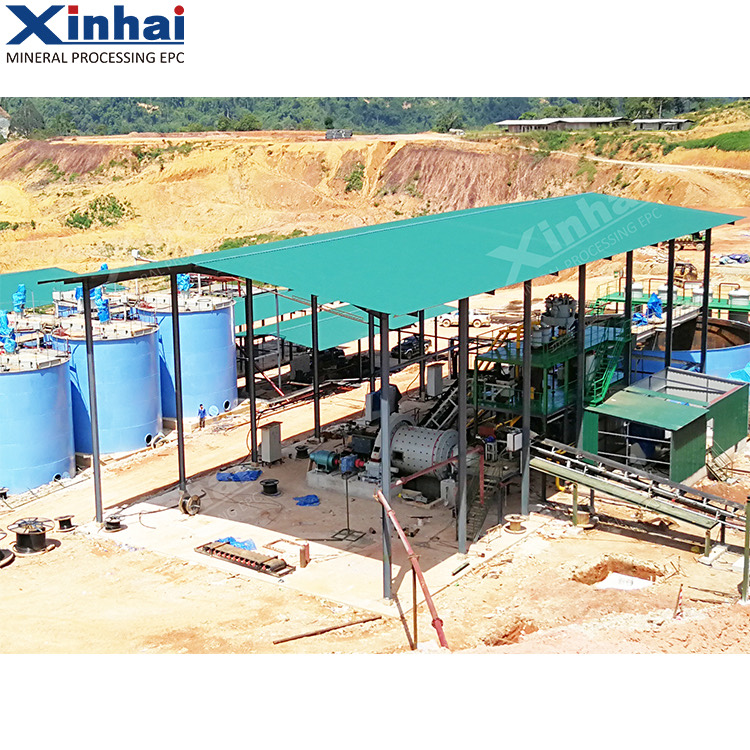
Tank-leach plants (CIP/CIL) need agitated leach and adsorption tanks, interstage screens, and an elution/EW gold room. The leach reactors themselves are the heart of the circuit; see our gold leaching agitation tanks and packaged CIP gold plant. Both routes start with the same comminution and classification front end, regardless of which leach method follows. For the complete tank-leach package, explore the gold extraction equipment hub, and for a turnkey build the CIP gold processing plant bundles crushing, grinding, leaching and the gold room.
Making the decision
Start with a representative ore sample and a bottle-roll or column test. Cyanide consumption, leach kinetics, preg-robbing index and gold grade from that testwork will point clearly to one route. As a rule of thumb: low-grade oxide and large tonnage favors heap leach; higher-grade or sulfide-associated ore favors tank leaching, with CIL chosen over CIP whenever preg-robbing or slow kinetics are a risk. Xinhai runs this testwork in-house and designs the matching plant under a single EPC+M+O contract, so the flowsheet, equipment and ramp-up support all come from one source.
Frequently Asked Questions
CIL or CIP for my gold ore?
Use CIL if the ore is preg-robbing, carbonaceous or leaches slowly, because carbon in the leach tanks captures gold before it can re-adsorb. Use CIP for clean, free-milling ores that fully leach before adsorption, which keeps carbon handling simpler and reduces attrition. Ore testwork settles the choice quickly.
What gold recovery can I expect from each method?
Tank-leach CIP and CIL plants typically achieve about 90-96% recovery on amenable ores, while heap leach usually returns 50-75% depending on ore type, crush size and percolation. These are typical ranges, not guarantees; your achievable recovery depends on mineralogy, grind size and leach time confirmed by testwork.
Is heap leach cheaper than a CIL plant?
Heap leach has the lowest capital and operating cost per tonne because it skips fine grinding and agitation, which is why it suits large low-grade oxide deposits. The trade-off is lower recovery and leach cycles measured in weeks to months. For higher-grade ore, the extra recovery from CIL usually outweighs its higher cost.
What capacity range do these plants cover?
Xinhai builds tank-leach gold plants from roughly 50 t/d for small operations up to several thousand t/d for large mines, all configurable to your throughput and ore. Heap leach scales with pad area and irrigation rate. We size every plant to your tested ore and target output rather than a fixed model.
How do I start a gold plant project with Xinhai?
Send a representative ore sample and your target throughput. Our lab runs leach and mineralogy testwork, recommends CIL, CIP or heap leach, and designs the flowsheet and equipment. We then deliver under one EPC+M+O contract covering design, manufacturing, installation and operator training. Reach us through the contact page to begin.