
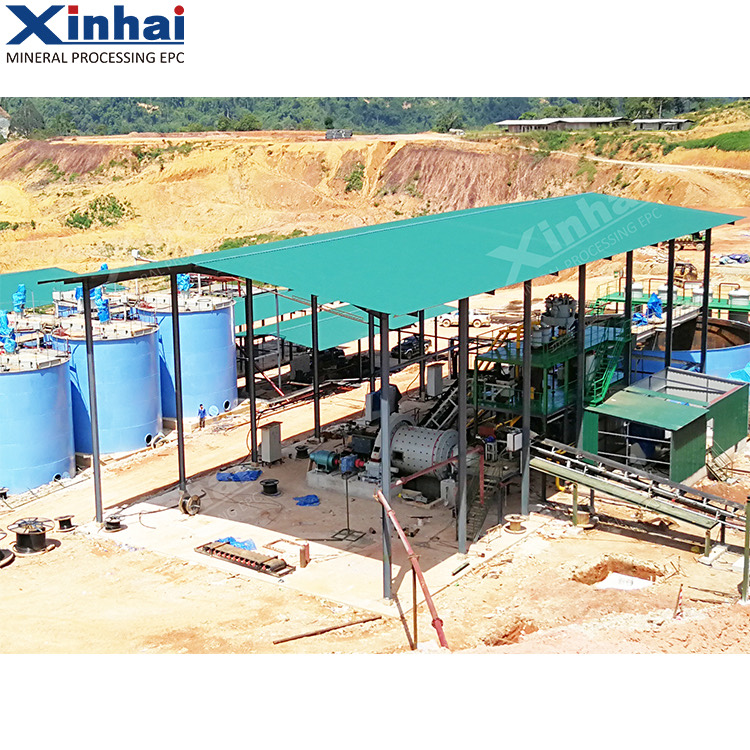
Background
This profile reflects a typical mid-scale gold operation in Nicaragua, part of Xinhai’s active Latin American market. The ore was a clean, free-milling, fast-leaching gold ore with a recoverable coarse-gold fraction. The owner wanted a 1,000 t/d plant with controlled operating cost, where the leach kinetics favored carbon-in-pulp rather than the simultaneous leach-adsorb of CIL.
Solution
Testwork confirmed the ore leached quickly and showed no significant preg-robbing, which made CIP the more economical route. After crushing and closed-circuit grinding to roughly 75-80% passing 200 mesh, a gold centrifugal concentrator and a shaking table recover coarse free gold ahead of leaching, cutting cyanide and carbon demand. The pulp is then leached in agitation tanks, after which carbon adsorbs the dissolved gold in a separate CIP train. Loaded carbon is stripped in a gold elution and electrowinning system to produce dore, and tailings are thickened and dewatered for water recovery.
Delivered as EPC+M+O, the project covered ore testing, in-house equipment manufacturing, installation, commissioning and operator training. Separating leaching from adsorption in the CIP layout reduced carbon inventory and attrition compared with a CIL circuit, which suited the clean ore and the owner’s cost target. The leach tanks were sized for full gold dissolution before the pulp reached the adsorption train, and inter-stage screens retained loaded carbon for counter-current transfer toward the feed end. Lime addition controlled pulp pH around the optimum for cyanidation while limiting reagent consumption.
Outcome
On a clean, fast-leaching free-milling ore, a gravity-plus-CIP circuit typically returns around 90-95% gold recovery once residence time and reagent dosing are tuned. Removing coarse gold by gravity first shortened the leach and helped contain reagent cost. These are representative ranges for this ore type, not guarantees; actual recovery tracks head grade, grind and leach conditions.
Operator training during ramp-up focused on carbon management and reagent control, the two variables that most affect day-to-day recovery on a CIP circuit. To compare adsorption routes, read our guide on CIL vs CIP vs heap leach and the underlying gold processing solution. To match a flowsheet to your ore, contact us for an ore test.
Frequently Asked Questions
Why was CIP chosen over CIL here?
The ore leached quickly and showed no preg-robbing, so adsorbing carbon after leaching rather than during it lowered carbon inventory and attrition without sacrificing recovery. CIP is often the more economical route on clean, fast-leaching gold ore, whereas CIL is preferred where dissolved gold must stay on carbon throughout the leach.
More projects
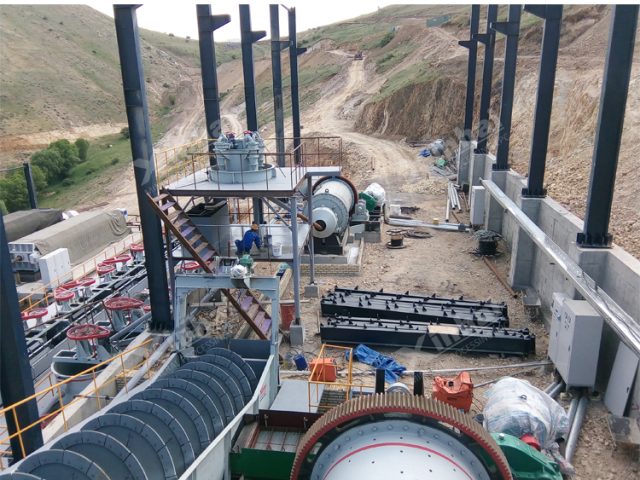
2 Mt/a Spodumene (Lithium) Plant — Zimbabwe
Typical 6% Li2O concentrate at 75-85% recovery; DMS plus flotation flowsheet
Read case →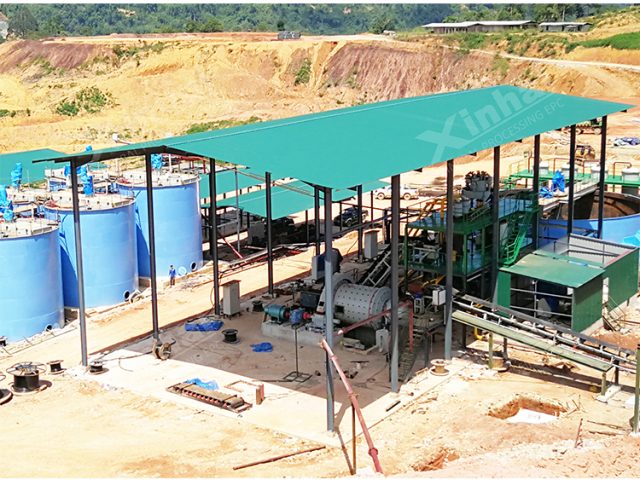
6,000 t/d Gold CIL Plant — Guinea
Typical 90-94% Au recovery on free-milling ore; built and commissioned to schedule
Read case →500 t/d Gold CIP Plant — Sudan
Typical 90-94% Au recovery on free-milling ore; compact CIP layout for fast deployment
Read case →