
Background
This profile represents a typical 1,500 t/d copper operation in the DR Congo Copperbelt, one of the world’s richest copper regions and a key market for Xinhai. The ore was a sulfide copper ore at a moderate head grade, and the owner needed a plant to upgrade run-of-mine ore to a saleable copper concentrate for sale to smelters and traders. Concentrate grade and copper recovery were the primary targets.
Solution
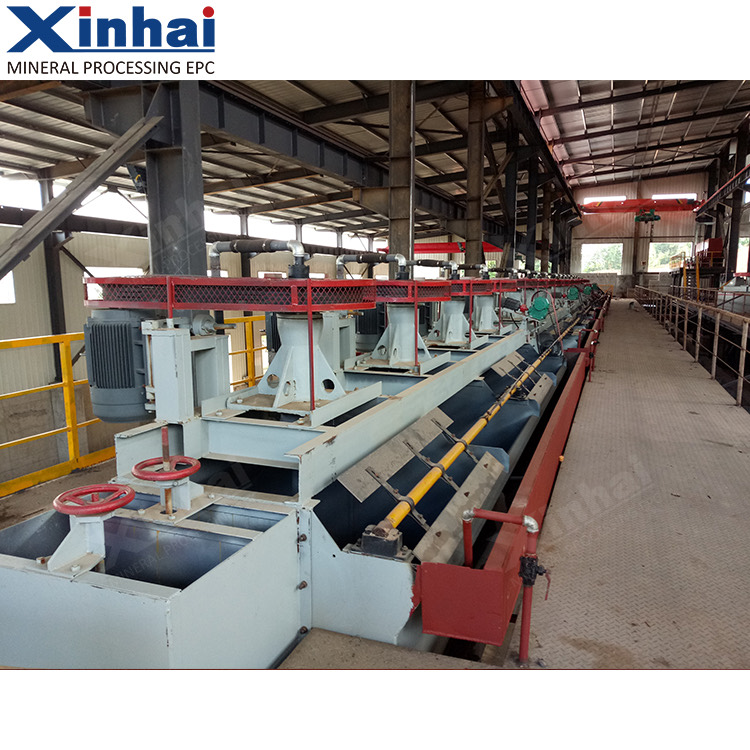
Testwork fixed the grind size for copper liberation and the reagent scheme (collector, frother and lime for pH control). The flowsheet is a conventional sulfide flotation circuit. After crushing and closed-circuit grinding with a wet ball mill to a suitable flotation feed size, the pulp is conditioned and floated through a rougher-scavenger-cleaner arrangement of JJF flotation cells. The packaged copper flotation plant integrates the cells, reagent dosing and froth handling. Rougher concentrate is reground as needed and cleaned to grade, while tailings are thickened in a deep cone thickener to recover process water before disposal. The final concentrate is filtered for shipment.
Delivered as EPC+M+O, the project covered ore testing, in-house manufacturing, construction, commissioning and operator training. Matching grind size and reagent regime to the ore in testwork was the decisive step: copper recovery in flotation is highly sensitive to liberation and pulp chemistry, so confirming both before sizing the circuit protected the recovery target. Rougher cells were sized for adequate residence time at the design solids density, and the scavenger bank recovered slow-floating composite particles that would otherwise report to tailings. Cleaner concentrate was upgraded in stages, with middlings recirculated to balance the grade-recovery trade-off rather than forcing grade in a single pass.
Outcome
A conventional rougher-cleaner flotation circuit on a moderate-grade sulfide copper ore typically recovers around 88-93% of the copper to a saleable concentrate, with concentrate grade tuned in the cleaning stages. Closed-circuit water recovery from the thickener also reduced fresh-water demand. These are representative ranges for the ore type, not guarantees; actual results depend on mineralogy, grind and reagent regime.
For the full flowsheet logic see the copper processing solution and our copper beneficiation flowsheet guide. To size a copper plant to your ore, contact us for an ore test.
Frequently Asked Questions
What copper concentrate grade is realistic from flotation?
Sulfide copper flotation typically produces a concentrate in the range commonly accepted by smelters, with the exact grade set in the cleaning stages and traded off against recovery. The achievable grade-recovery balance depends on copper mineralogy, grind size and reagent scheme, all confirmed in testwork before the rougher and cleaner banks are sized.
Does the plant handle oxide copper as well as sulfide?
This profile is a sulfide flotation plant. Oxide copper does not float well and is usually treated by leaching (heap or agitation) followed by solvent extraction and electrowinning. Mixed oxide-sulfide ores may need a combined flowsheet. Xinhai confirms copper mineralogy in testwork first, since it determines whether flotation, leaching or both are required.
More projects
500 t/d Gold CIP Plant — Sudan
Typical 90-94% Au recovery on free-milling ore; compact CIP layout for fast deployment
Read case →6,000 t/d Gold CIL Plant — Guinea
Typical 90-94% Au recovery on free-milling ore; built and commissioned to schedule
Read case →700 t/d Gold CIL Plant — Tanzania
Typical 89-93% Au recovery; CIL chosen to counter mild preg-robbing
Read case →