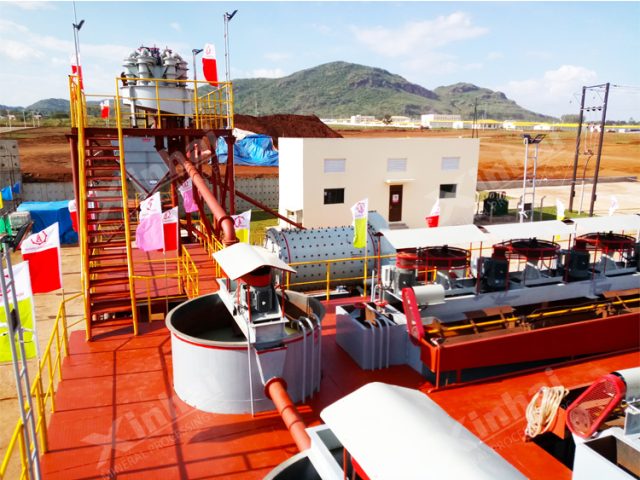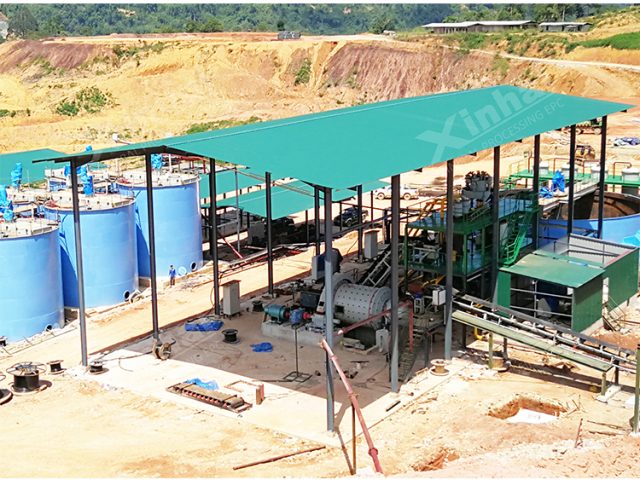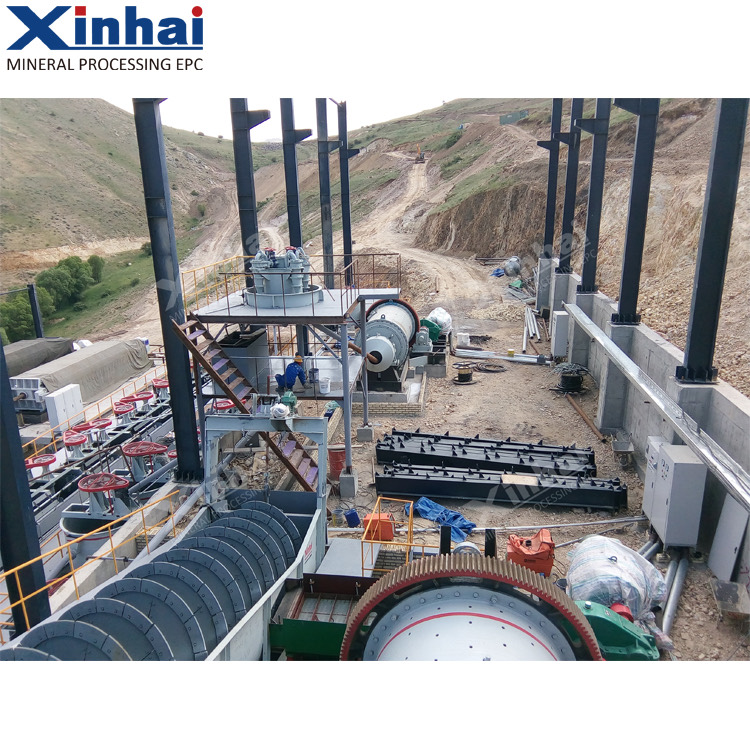
Hard-rock spodumene upgrading, end to end
Spodumene is the dominant hard-rock lithium mineral, and turning a 1 to 1.5 percent Li2O ore into a marketable 5.5 to 6 percent Li2O concentrate takes a carefully staged flowsheet rather than a single machine. Xinhai designs and supplies complete spodumene lines, with a 1,000 tpd configuration as a common starting point, scaled up or down to suit your reserve grade, mineralogy and product specification. Each stage is balanced so the plant hits the concentrate grade buyers and converters demand.
A typical spodumene flowsheet
After crushing and screening, many spodumene ores benefit from dense-media separation (DMS) to reject low-grade coarse waste cheaply before fine grinding, which is where most of the energy cost sits. The DMS concentrate and middlings are then ground and treated by flotation, where conditioned reagents float spodumene away from feldspar, quartz and mica. Magnetic separation removes iron-bearing minerals to meet the low-iron spec that converters require, and the concentrate is thickened and dewatered for shipping while process water is recovered and recycled.
DMS plus flotation, sized to the ore
- DMS pre-concentration: rejects coarse barren rock early, cutting downstream grinding and flotation load and lowering reagent cost.
- Grinding: liberation typically targets a fine grind so spodumene floats cleanly; the exact size comes from ore testing, not a generic rule.
- Flotation: upgrades to a 5.5 to 6 percent Li2O concentrate, with recoveries commonly in the 75 to 90 percent range on suitable ore.
- Iron removal: magnetic separation trims iron to meet battery- or technical-grade limits.
Mica and iron content are the two specs that most often decide whether a concentrate is saleable, so the cleaner and magnetic stages are designed around them rather than bolted on afterward. Reagent regime and grind size are confirmed on your own ore in the lab before any equipment is sized.
Delivered as one EPC scope
Lithium projects move fast, and a single-source plant keeps the DMS, grinding, flotation and dewatering stages balanced as one design with one party accountable. Under our EPC+M+O model, Xinhai handles ore characterization, flowsheet and plant design, in-house manufacturing, installation and operator training. Explore our mineral processing plants, read the spodumene processing flowsheet guide, or contact us with your ore data.
Technical Specifications
| Plant type | Spodumene (lithium) upgrading line |
|---|---|
| Base capacity | 1,000 t/d (200u20132,000 t/d configurable) |
| Feed | Hard-rock spodumene, ~1u20131.5% Li2O |
| Concentrate grade | 5.5u20136% Li2O (ore-dependent) |
| Typical recovery | 75u201390% on suitable ore |
| Core process | Crushing, DMS, grinding, flotation, magnetic cleaning |
| Iron control | Magnetic separation for low-Fe spec |
| Delivery model | Turnkey EPC+M+O, OEM/ODM |
Frequently Asked Questions
What Li2O concentrate grade does the plant produce?
A properly designed spodumene line produces a 5.5 to 6 percent Li2O concentrate, which is the typical chemical- and technical-grade target. The achievable grade and recovery depend on ore mineralogy and liberation, so we run flotation testwork before fixing the flowsheet and product specification for your deposit.
Do I need DMS or just flotation?
It depends on the ore. Dense-media separation pre-concentrates coarse spodumene and rejects barren rock cheaply, cutting grinding and flotation costs, which suits ores with a clear density contrast. Some fine-grained ores go straight to flotation. We test your ore and recommend the most economical combination.
Can you meet battery-grade iron limits?
Yes. We add magnetic separation to strip iron-bearing minerals from the spodumene concentrate so it meets the low-iron limits that lithium converters require for chemical-grade feed. The exact circuit, whether wet drum, high-intensity or both, depends on the iron mineralogy in your ore, which we characterize during testwork before fixing the flowsheet and guaranteeing a product specification.
How much does a 1,000 tpd spodumene plant cost?
Pricing starts around US$94,500 for a base line and scales with throughput, the DMS and flotation scope and the degree of automation. After reviewing your ore data and product target, we provide an itemized budget covering equipment, installation and commissioning.