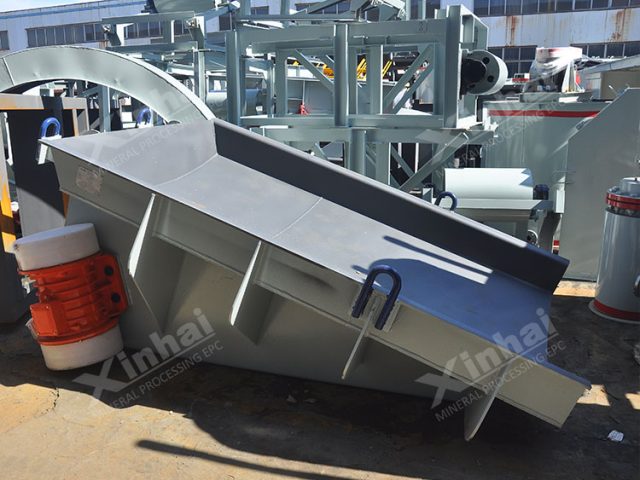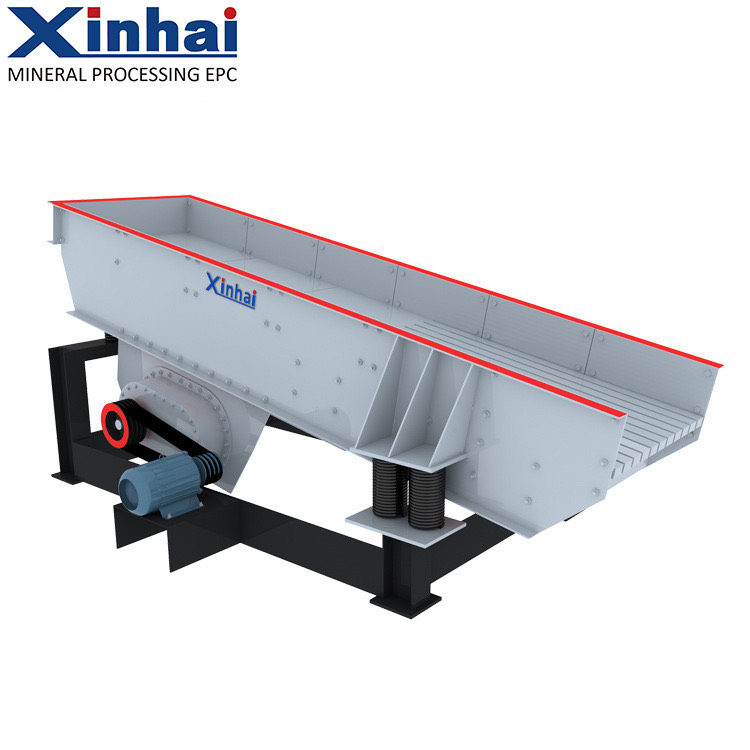
What the ZSW grizzly feeder does
Every crushing plant starts with a feeder, and the ZSW vibrating grizzly feeder is the standard choice ahead of primary crushing. It sits under the dump hopper and delivers a steady, controlled stream of run-of-mine ore to the jaw crusher, smoothing out the surges that come from a truck or loader tipping. Just as important, its grizzly section pre-screens the feed so the crusher only handles rock that actually needs crushing.
How it works
Twin vibrating motors (or an eccentric exciter) drive the feeder trough in a linear motion that conveys material forward. The first section is a solid pan; the discharge section is a grizzly of spaced, wear-resistant bars. As ore travels along, fines and dirt below the bar spacing drop through and bypass the crusher, while oversize continues into the crushing chamber. Bar gap is set to your crusher’s closed-side setting so you never crush material that is already on size.
Why pre-screening pays
Scalping fines before the crusher is one of the cheapest ways to raise plant capacity. Removing 10-25% undersize means the crusher does less work, wears more slowly and passes more on-spec product. As a rule of thumb, the more fines and clay in your run-of-mine, the more a grizzly section earns its keep. Xinhai sizes trough width, length and bar gap to your feed and to the crusher mouth it serves.
- Surge control for steady choke-feeding of the crusher
- Grizzly bars that scalp fines and bypass the crusher
- Wear-lined trough for abrasive run-of-mine
- Adjustable amplitude to set the feed rate
Selection and operation
The feeder should be sized to comfortably exceed the crusher’s appetite so it never starves the chamber, with feed rate trimmed by the vibrating-motor amplitude or a variable-speed drive. The fines that drop through the grizzly typically join the crusher product on a vibrating screen downstream. For finer, controlled metering into furnaces or grinding circuits, see the electromagnetic vibrating feeder.
Browse the full feeders and conveying range. A well-matched feeder is the foundation of a stable crushing circuit, so for sizing help contact our engineers.
Technical Specifications
| Capacity | 30-1,000 t/h (configurable) |
|---|---|
| Max feed size | Up to ~1,000 mm |
| Grizzly bar gap | Set to crusher CSS (customizable) |
| Drive | Twin vibrating motors / eccentric exciter |
| Motor power | 2x1.5 to 2x37 kW |
| Trough lining | Wear-resistant plate |
| Feed-rate control | Amplitude / variable-speed drive |
| Application | Primary feed & scalping ahead of crushing |
| Customization | OEM / ODM, sized to crusher mouth |
Frequently Asked Questions
What does the grizzly section do?
The grizzly bars at the discharge end pre-screen the feed: fines and dirt smaller than the bar gap drop through and bypass the crusher, while oversize continues into the chamber. This stops the crusher from re-handling material that is already on size, raising plant capacity and reducing crusher wear, especially on dirty or clay-bearing run-of-mine.
What capacity grizzly feeder do I need?
Size the feeder to comfortably exceed your crusher's throughput so the chamber stays choke-fed and never starves. Xinhai ZSW feeders cover roughly 30-1,000 t/h. We match trough width and length to your largest boulders and the crusher mouth, then set bar gap to the crusher's closed-side setting.
Can the bar gap be changed for different ore?
Yes. The grizzly bar spacing is set to the crusher's closed-side setting and can be specified for your material; bars are wear parts and are replaceable. For dirty or fines-heavy feed a tighter gap scalps more, lifting capacity. We configure the gap and bar profile to your run-of-mine when building the unit.
How is the feed rate controlled?
Feed rate is set by the vibrating-motor amplitude or an optional variable-speed drive, letting operators trim the flow to keep the crusher fully fed without overloading it. Smooth, surge-free feeding is what allows a crusher to run at its rated capacity, so a properly tuned feeder directly improves crushing-circuit output.